
Publish date: February 14, 2026
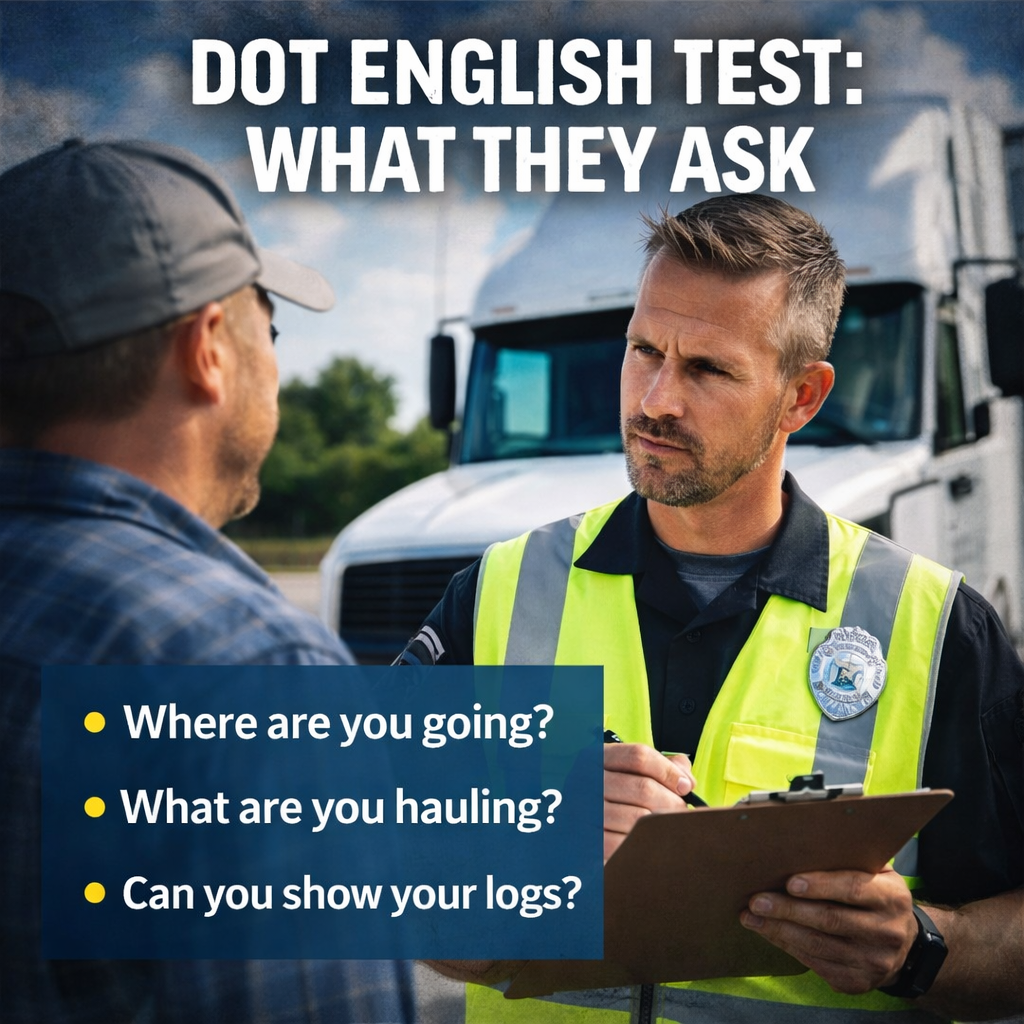
What does the DOT ask in the English test?
DOT is not giving you a classroom English test. This is a roadside communication check. The inspector is confirming one thing: can you understand instructions and answer basic official questions in English well enough to operate safely and complete an inspection.
This post is the practical “what to expect” guide. If you want the rule + OOS consequence breakdown, read: Can DOT put me out of service for English?
🎙️ Behind the wheel? Click here and listen to the full DOT English Proficiency breakdown: Watch on YouTube
Want the ELP guide + the full compliance download library in one place? Unlock the Free DOT Compliance Checklist Bundle.
What DOT is really testing at roadside
Think of this like a pre-trip inspection for communication. The inspector is checking whether you can:
- Understand basic instructions (where to pull, what to hand over, what to do next)
- Answer simple official questions without guessing
- Explain your situation clearly (trip, logs, paperwork) in plain English
Big point: You do not need perfect grammar. You do need clear, inspection-focused answers.
What DOT asks in the interview
DOT questions usually stay inside a few predictable lanes. If you prep these lanes, you’re not walking into the stop cold.
Lane 1: Trip and load basics
What they’re checking: Can you communicate where you’re going and what you’re hauling.
- Where are you coming from?
- Where are you going?
- What are you hauling?
- Who is your carrier/company?
Good answer style: short, direct, no extra story.
Lane 2: Logs / HOS / ELD basics
What they’re checking: Can you explain your duty status and show your log.
- Are you on-duty or off-duty right now?
- How long have you been driving today?
- Can you show your ELD/logs?
Reality check: A lot of drivers get nervous here and start rambling. Don’t. Just answer what was asked and then show the log.
Lane 3: Paperwork and documents
What they’re checking: Can you identify and provide your required documents without confusion.
- Do you have your CDL and medical card?
- Do you have the shipping papers / bill of lading?
- Can you show the registration/insurance (if requested)?
Lane 4: Vehicle and inspection instructions
What they’re checking: Can you follow safety instructions during the inspection process.
- Pull forward / stop / set brakes
- Turn lights on/off
- Open trailer / hood (if instructed)
Translation: it’s not a quiz—it’s operational communication.
How to answer so the stop stays calm
If you want a simple rule that works: one question → one answer → then stop talking.
Here are examples of the style you want (short and clean):
- Question: Where are you going?
Answer: “To Charlotte, North Carolina.” - Question: What are you hauling?
Answer: “Dry goods. General freight.” - Question: Who do you drive for?
Answer: “Freight Pro Hub Logistics.” (or your company name) - Question: Can you show your ELD?
Answer: “Yes. One moment.” (then show it)
Why this works: it shows the inspector you understand and can respond. Long explanations can accidentally reveal confusion.
What NOT to do (this is where drivers get burned)
- Don’t guess. If you don’t understand, say: “Please repeat slowly.”
- Don’t argue or debate. That escalates the stop and wastes time.
- Don’t ramble. More words = more chances to sound confused.
- Don’t rely on translation tools during the assessment. FMCSA guidance says communication assistance tools should not be used during the driver interview portion.
Trucking comparison: This is like backing into a tight dock. Slow, controlled, and intentional beats fast and sloppy every time.
What if you don’t understand the question?
This is the safest move:
- “Please repeat slowly.”
- “I do not understand. Please say again.”
That’s better than guessing. Guessing can make you look like you understand when you don’t—and that’s the exact issue ELP enforcement is targeting.
What about the sign recognition part?
If the inspector moves to sign recognition, the focus is usually on what the sign means and what action you would take. That’s why this post is paired with:
Do I have to read every road sign for DOT?
In that post, I break down what DOT is looking for with MUTCD-style sign comprehension and why safety communication is the real goal.
Quick prep plan you can start today
- Practice the four lanes: trip, logs, paperwork, inspection instructions.
- Keep answers short: one question → one answer.
- Know your document words: “bill of lading,” “shipping papers,” “ELD,” “logs,” “medical card.”
- Know common signs: lane closed, detour, chains required, weigh station, reduced speed.
Want the checklists and guides that keep you inspection-ready? Get access here: Free DOT Compliance Checklist Bundle.
Next reads in this cluster
- The English Rule: Can DOT Put Me Out of Service for English?
- English for Safety: Why Sign Recognition Is the Focus of Roadside Language Checks
- Why did my insurance go up after one CSA point?
- How to get a ticket off my CSA record in 2026
Sources
- FMCSA: English Language Proficiency Enforcement Guidance (May 20, 2025) (PDF)
- FMCSA: FAQ on assessing ELP during driver qualification (May 22, 2025)
- FHWA: Manual on Uniform Traffic Control Devices (MUTCD)
Regulatory note: Regulations, enforcement guidance, and inspection procedures can change. Always verify current requirements using FMCSA/CVSA sources before making compliance decisions.