
Publish date: February 14, 2026
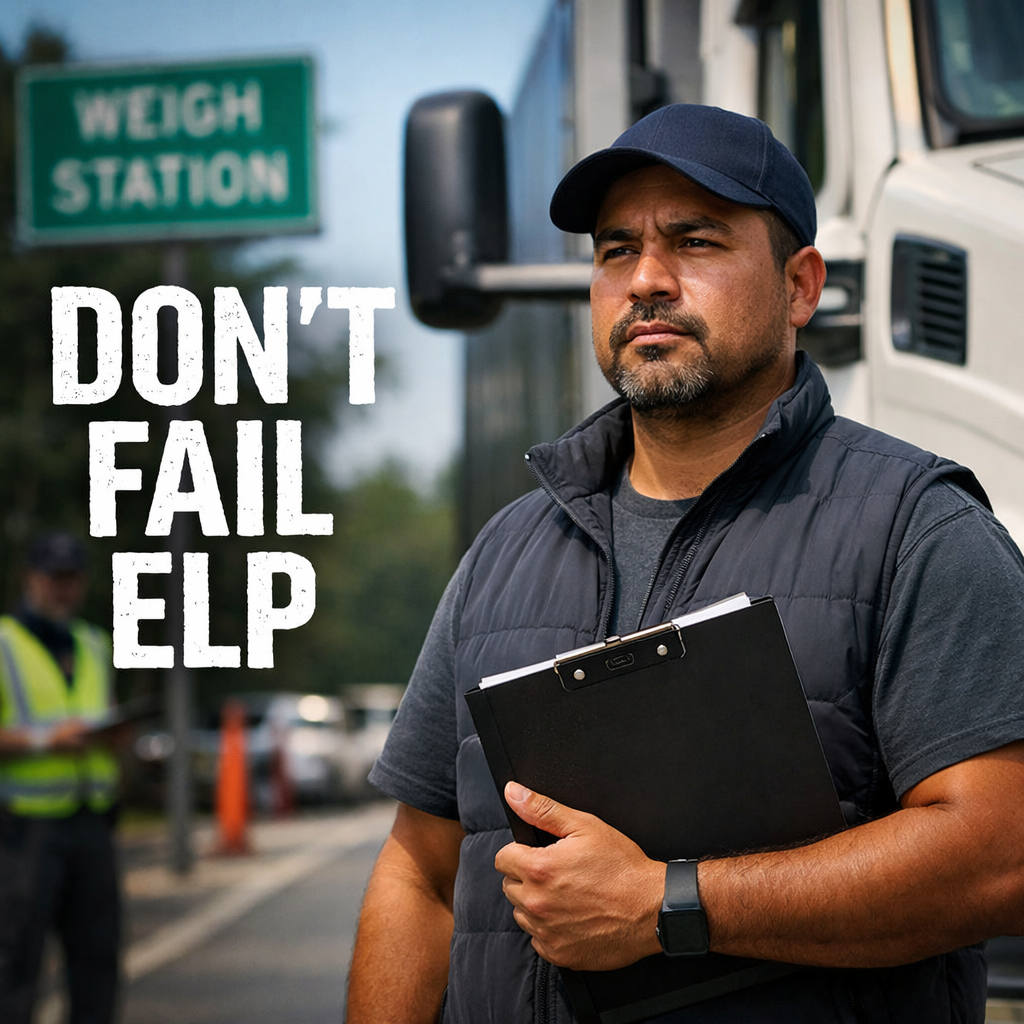
Can DOT put me out of service for English?
Yes. A DOT inspector can place a driver out of service (OOS) for failing the federal English Language Proficiency (ELP) requirement tied to 49 CFR § 391.11(b)(2). The important part is this: ELP is treated as a driver qualification issue. So even if your truck is clean and your paperwork is solid, communication problems at roadside can still put your day (and your load) at risk.
In this guide, I’m going to keep it straight: what the rule requires, what changed in enforcement, how inspectors assess ELP at roadside, and what drivers and carriers can do to reduce the chances of getting parked.
🎙️ Behind the wheel? Click here and listen to the full DOT English Proficiency breakdown: Watch on YouTube
Want the ELP guide + the full checklist library? Unlock the Free DOT Compliance Checklist Bundle.
Why is DOT enforcing English proficiency more aggressively now?
The English proficiency requirement itself isn’t new. What changed is the enforcement posture and how ELP is treated during inspections. That’s why drivers started feeling this more in 2025 and why it’s still a big deal heading into 2026.
Here’s the short timeline. I’m listing it so you can ground your decisions in official dates—not internet noise:
- April 28, 2025: Executive Order 14286 directed enforcement of the English-language requirement for CMV drivers. (White House EO page)
- May 20, 2025: FMCSA issued ELP enforcement guidance (internal policy memo). (FMCSA ELP guidance PDF)
- June 25, 2025: CVSA’s updated Out-of-Service Criteria made non-compliance with the ELP requirement a driver OOS condition. (CVSA update)
Why that matters: roadside enforcement is guided by these policies and criteria. So the practical reality is simple—if communication fails, the stop can escalate quickly. Next, let’s lock in what the rule actually requires so you know what “pass” looks like.
What does the ELP rule actually require?
Under 49 CFR § 391.11(b)(2), a driver must be able to read and speak English sufficiently to do specific job functions. This isn’t about sounding perfect or having an accent. It’s about being able to complete the safety and compliance functions that happen during real operations.
A driver must be able to:
- Converse with the general public
- Understand highway traffic signs and signals in English
- Respond to official inquiries
- Make entries on reports and records
That’s the standard DOT is tying this to—communication for safety, records, and inspection activity.
Source: 49 CFR § 391.11 (eCFR)
How does DOT actually assess English proficiency at roadside?
FMCSA describes a two-step approach that begins with communication during the stop. In plain terms: the inspector is evaluating whether you can understand questions, follow instructions, and respond clearly enough to complete an inspection safely.
Step 1: Driver interview
This is the first “make or break” moment. The inspector evaluates whether the driver can understand questions and respond appropriately in English. If Step 1 goes sideways, the stop usually gets longer and more intense—not because the inspector is trying to be dramatic, but because they can’t rely on clear communication.
Step 2: Highway traffic sign recognition assessment (if needed)
If needed, an inspector may use a sign/signal recognition assessment. FMCSA has stated that if a driver does not successfully complete Step 1, there’s no need to perform Step 2. In other words: failing the interview is enough to end the process.
Source: FMCSA ELP FAQs (CVSA Training Committee page)
Can DOT put me out of service for English even if everything else is clean?
Yes. If an inspector determines a driver does not meet the ELP requirement in 49 CFR § 391.11(b)(2), the driver can be cited. Because ELP is treated as a driver OOS condition under the out-of-service criteria used at inspections, that can lead to the driver being placed out of service.
Here’s the part most drivers miss: a “clean truck” does not protect you from a driver qualification issue. If communication breaks down badly enough, it can override everything else you did right that day.
Official references: 49 CFR § 391.11 (eCFR) • CVSA ELP OOS criteria update
Important exception for border commercial zones near the U.S.-Mexico border
FMCSA guidance notes an exception for inspections occurring in border commercial zones along the U.S.-Mexico border. In that specific context, enforcement personnel should cite the violation but refrain from placing the driver out-of-service or initiating disqualification action. This is a narrow exception tied to a specific geography—don’t assume it applies outside that zone.
Source: FMCSA ELP FAQs / enforcement procedure notes
What drivers should do before the next inspection
Think of ELP like load securement: you don’t argue with physics—you prepare so you don’t get hurt. Same thing here: you prepare so you don’t get parked. The goal is simple: short, clear answers and fast access to documents.
- Keep answers short and direct. Where you’re going, what you’re hauling, who you drive for, log status.
- Don’t guess. If you don’t understand the question, ask for it to be repeated slowly.
- Stop fumbling. Know exactly where your CDL/med card, ELD/log view, and load paperwork are.
- Know common road sign meanings. The rule explicitly ties English to sign/signal comprehension.
In the next post, I’ll break down what DOT typically asks in the interview and how drivers should answer without rambling.
Want the full checklist library (including the ELP guide)? Get instant access here: Free DOT Compliance Checklist Bundle
What carriers and small fleets should do
ELP isn’t just “a driver problem.” It’s a driver qualification issue. If you’re dispatching drivers, you need a basic screening process so roadside isn’t the first time a weakness gets exposed.
Think of it like this: if you’d never dispatch a driver without a valid medical card, you shouldn’t dispatch a driver who can’t reliably communicate during an inspection either. It’s the same risk category—qualification and enforcement exposure.
- Add ELP screening to onboarding. Document that you assessed the driver’s ability to respond to official inquiries and understand signs/safety communication.
- Use the same screening questions for every driver. Consistency protects the business.
- Coach what matters. Calm, short, inspection-focused answers beat long explanations.
Reference: FMCSA ELP guidance PDF
Next reads in this cluster
If you want the “how” behind ELP enforcement, these connect directly to this post:
- Roadside Interviews: What to Expect When an Inspector Tests Your English Proficiency
- English for Safety: Why Sign Recognition is the Focus of Roadside Language Checks
- SMS Profile Management: How to Monitor Your Carrier Score in the Modernized System
- Disputing Violations: Using the 2026 DataQ Transparency Rules to Fight Back
Sources (official)
- 49 CFR § 391.11 (eCFR)
- CVSA: ELP added as a driver OOS condition (effective June 25, 2025)
- FMCSA: ELP guidance memo (May 20, 2025 PDF)
- FMCSA: ELP FAQs / enforcement procedure notes
- White House: Executive Order 14286 (April 28, 2025)
Regulatory note: Regulations, enforcement guidance, and out-of-service criteria can change. Always verify current requirements using FMCSA and applicable enforcement criteria before making compliance decisions.