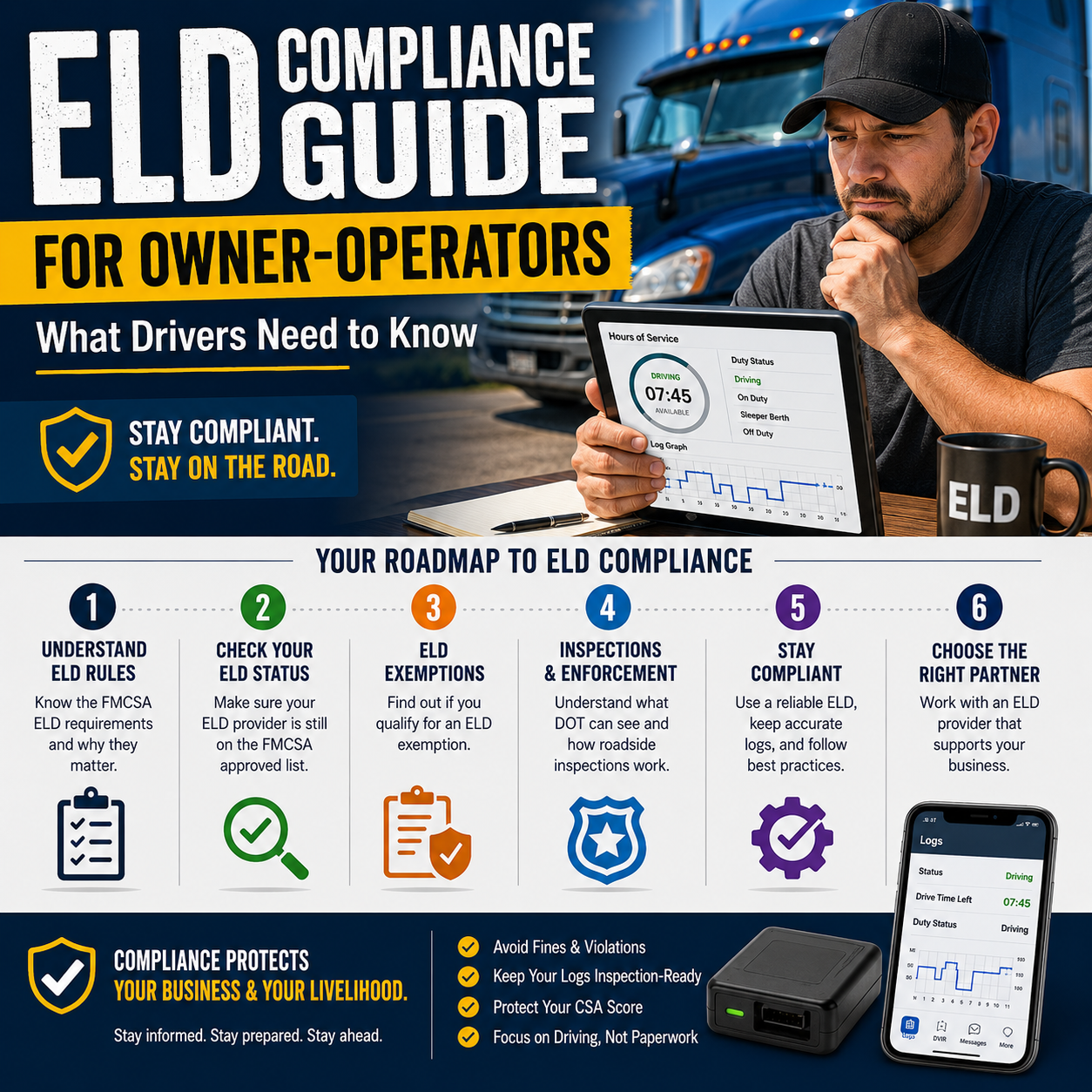
ELD Compliance Guide for Owner-Operators: What Drivers Need to Know
ELDs are one of those topics that never seem to go away.
Every time FMCSA removes another ELD provider, updates enforcement, or drivers start talking about inspections, the same questions come back up.
Do I need an ELD?
Is my ELD still approved?
What happens if DOT checks it?
Can I still use paper logs?
What ELD should I trust?
This guide is here to help you find the answer without digging through government language.
Think of this page as your starting point for understanding ELD compliance in plain English.
Why ELD Compliance Matters
An ELD is not just another device stuck to the dash.
For many owner-operators, it connects directly to Hours of Service records, roadside inspections, audits, and overall compliance.
When everything works, most drivers barely think about it.
But when something goes wrong, that ELD can become the problem real fast.
Start Here: Why Does FMCSA Keep Removing ELDs?
If you have been wondering why FMCSA keeps removing ELD providers from the approved list, this is the first article to read.
It explains why some providers get revoked, what self-certification means, and why drivers should pay attention before their device becomes a compliance problem.
👉 See Why FMCSA Keeps Removing ELDs
Check If Your ELD Has Been Revoked
Before you panic or buy another system, check whether your provider has actually been removed from the FMCSA registry.
If your ELD provider is on the revoked list, you need to know what that means and how quickly you may need to act.
👉 Check the Revoked ELD Providers List
Do You Even Need an ELD?
Not every driver is required to use an ELD.
Some drivers qualify for exemptions, including certain short-haul operations, occasional log users, driveaway-towaway operations, and qualifying pre-2000 vehicles.
The key is knowing whether the exemption truly applies to your operation.
👉 See Who Qualifies for an ELD Exemption
What Happens If DOT Catches You Using the Wrong ELD?
If your ELD is revoked, non-compliant, malfunctioning, or unable to transfer logs, that can create real problems during an inspection.
This article explains what can happen when DOT finds an issue and why the cheapest ELD is not always the safest business decision.
👉 Learn What Happens When You Use the Wrong ELD
What Does DOT Actually See When They Check Your ELD?
During a roadside inspection, DOT may review more than just today’s log.
They may look at duty status changes, edits, transfers, unassigned driving time, malfunctions, and whether your records tell a believable story.
👉 Learn What DOT Checks on Your ELD
Looking for a More Reliable ELD Option?
If your current ELD is hard to use, poorly supported, or making inspections more stressful than they need to be, it may be time to look at better options.
Motive gives owner-operators and small fleets tools for electronic logs, GPS tracking, safety monitoring, fleet visibility, and compliance support in one platform.
👉 Stay Ahead of ELD Compliance Problems
Why Owner-Operators Are Switching to Motive
Many owner-operators are not switching because they want more technology.
They are switching because they want fewer headaches, better support, cleaner logs, and a system that can grow with their business.
👉 See Why Owner-Operators Are Switching to Motive
Final Thoughts
ELD compliance does not have to be confusing.
The main thing is knowing where your operation stands.
Know whether you need an ELD.
Know whether your provider is still approved.
Know what DOT can review during an inspection.
And if your current system is creating more stress than support, do not wait until it becomes a roadside problem.
In trucking, staying ahead of compliance problems is usually cheaper than fixing them after they happen.