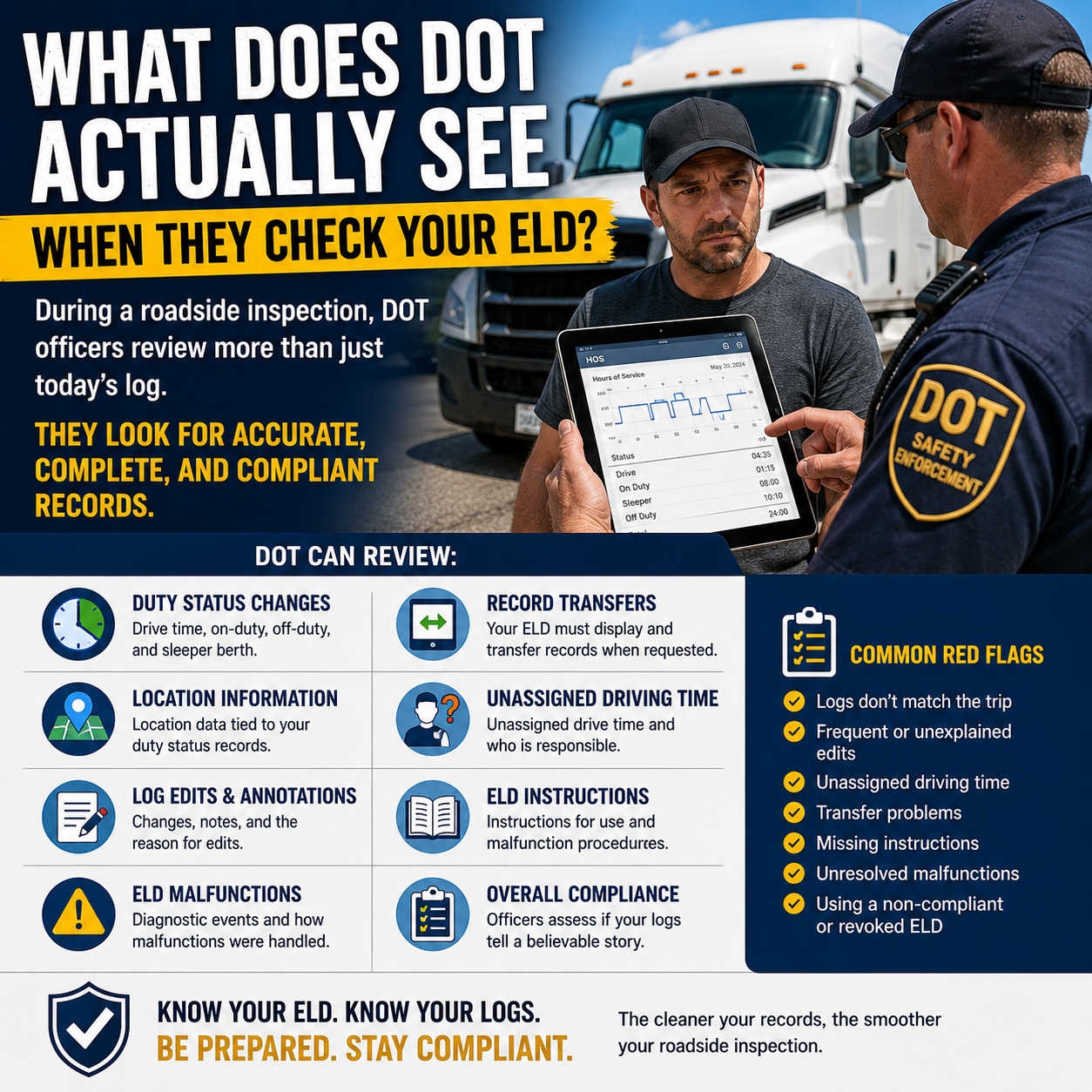
What Does DOT Actually See When They Check Your ELD?
Every driver knows that feeling.
You pull into a scale house, DOT asks for your logs, and suddenly that ELD on your dash matters a whole lot more than it did five minutes ago.
Most drivers know DOT can check their ELD.
But the real question is:
“What does DOT actually see when they check it?”
Let’s break it down in plain English.
DOT Is Looking at More Than Just Today’s Log
A lot of drivers think the officer is only looking at the current day.
That’s not always true.
During a roadside inspection, the officer may review your current duty status, recent logs, supporting information, and whether your ELD can properly transfer records.
The officer is not just asking, “Are you driving legal right now?”
They’re also looking for signs that the records make sense.
Your ELD Must Be Able to Show and Transfer Records
This is one of the biggest things drivers need to understand.
It is not enough for your ELD to turn on.
It is not enough for the screen to show a graph.
If DOT asks for your records, your ELD must be able to display and transfer the required information.
That is where some drivers get caught off guard.
The device may look fine until it is time to send the records.
Then suddenly everybody is standing there trying to figure out why the transfer will not work.
What Information Can DOT Review?
DOT may review information connected to your Hours of Service records.
That can include things like:
- Your duty status changes
- Driving time
- On-duty time
- Off-duty time
- Sleeper berth time
- Location information tied to duty status records
- Edits and annotations
- Unassigned driving time
- ELD malfunction indicators
In plain English, DOT is trying to see whether your logs tell a believable story.
If the truck moved, the records should explain who was driving and how that time was handled.
Unassigned Driving Time Can Raise Questions
Unassigned driving time is one of those things that can make an inspection uncomfortable.
If the truck moved and that driving time is not assigned to a driver, somebody needs to explain it.
Maybe it was a yard move.
Maybe it was a mechanic.
Maybe somebody forgot to log in.
The point is, it should not just be sitting there ignored.
When unassigned drive time piles up, it can look like poor log management.
And when DOT sees poor log management, they may start looking closer.
Log Edits Matter Too
Drivers sometimes think edits are no big deal.
But edits can tell a story.
If your logs are constantly being changed, corrected, or cleaned up after the fact, that can raise questions.
That does not mean every edit is a violation.
Drivers make mistakes.
Dispatch changes.
Real life happens.
But edits should be properly handled and explained when needed.
The cleaner your records are before inspection day, the less explaining you usually have to do.
DOT May Also Look for ELD Malfunctions
If your ELD has a malfunction or data diagnostic event, that can show up during an inspection.
The problem is not always that the device had an issue.
Technology messes up sometimes.
The bigger issue is whether the driver and carrier handled the problem correctly.
If the ELD malfunctioned, did you document it?
Did you reconstruct the records if needed?
Did you follow the repair or replacement process?
That is what matters.
The Officer May Ask for Your ELD Instructions
This is one of those simple things that still catches drivers off guard.
You are supposed to have ELD information available in the truck, including instructions for using the device and handling malfunctions.
If DOT asks and you cannot produce what is required, now a simple inspection can turn into a bigger headache.
This is not complicated.
Keep the required ELD instructions accessible.
Make sure the driver knows where they are.
That small detail can save stress at the scale house.
What Creates Red Flags During an ELD Inspection?
From a driver standpoint, these are the things that can make DOT start asking more questions:
- Logs that do not match the trip
- Unassigned driving time
- Frequent unexplained edits
- ELD transfer problems
- Missing ELD instructions
- Malfunctions that were not handled properly
- Using a revoked or non-compliant ELD
None of this means a driver needs to be scared of the ELD.
It just means the records need to be clean, explainable, and ready before DOT asks for them.
Do Not Learn Your ELD at the Scale House
This might be the biggest practical takeaway.
Do not wait until an officer is standing at your window to figure out how your ELD works.
Before inspection day, you should already know:
- How to display your logs
- How to transfer your records
- Where the ELD instructions are stored
- How to handle malfunctions
- How to access previous records
That is not extra work.
That is part of protecting your business.
Want Roadside Inspections to Feel Less Stressful?
If your ELD is hard to use, hard to transfer, or hard to get support for, roadside inspections can feel more stressful than they need to be.
A reliable ELD should help you stay organized, show records clearly, and keep your operation prepared when DOT asks questions.
👉 Simplify Your Next DOT ELD Inspection
Final Thoughts
DOT checking your ELD should not feel like a mystery.
The officer is looking at whether your Hours of Service records are accurate, complete, and available when required.
If your records are clean and your ELD works the way it should, the inspection usually feels a lot less stressful.
But if your ELD is unreliable, your records are messy, or you do not know how to transfer your logs, the inspection can go sideways fast.
Know your system before DOT asks.
Because the scale house is not the place to start learning it.
Related Articles
What Happens If DOT Catches You Using the Wrong ELD?
If your ELD is revoked, non-compliant, or unable to transfer logs, this article explains what can happen next.
👉 Learn What Happens When You Use the Wrong ELD
Why Does FMCSA Keep Removing ELDs?
If you are wondering why ELD providers keep getting removed from the FMCSA list, this article explains what is really happening.