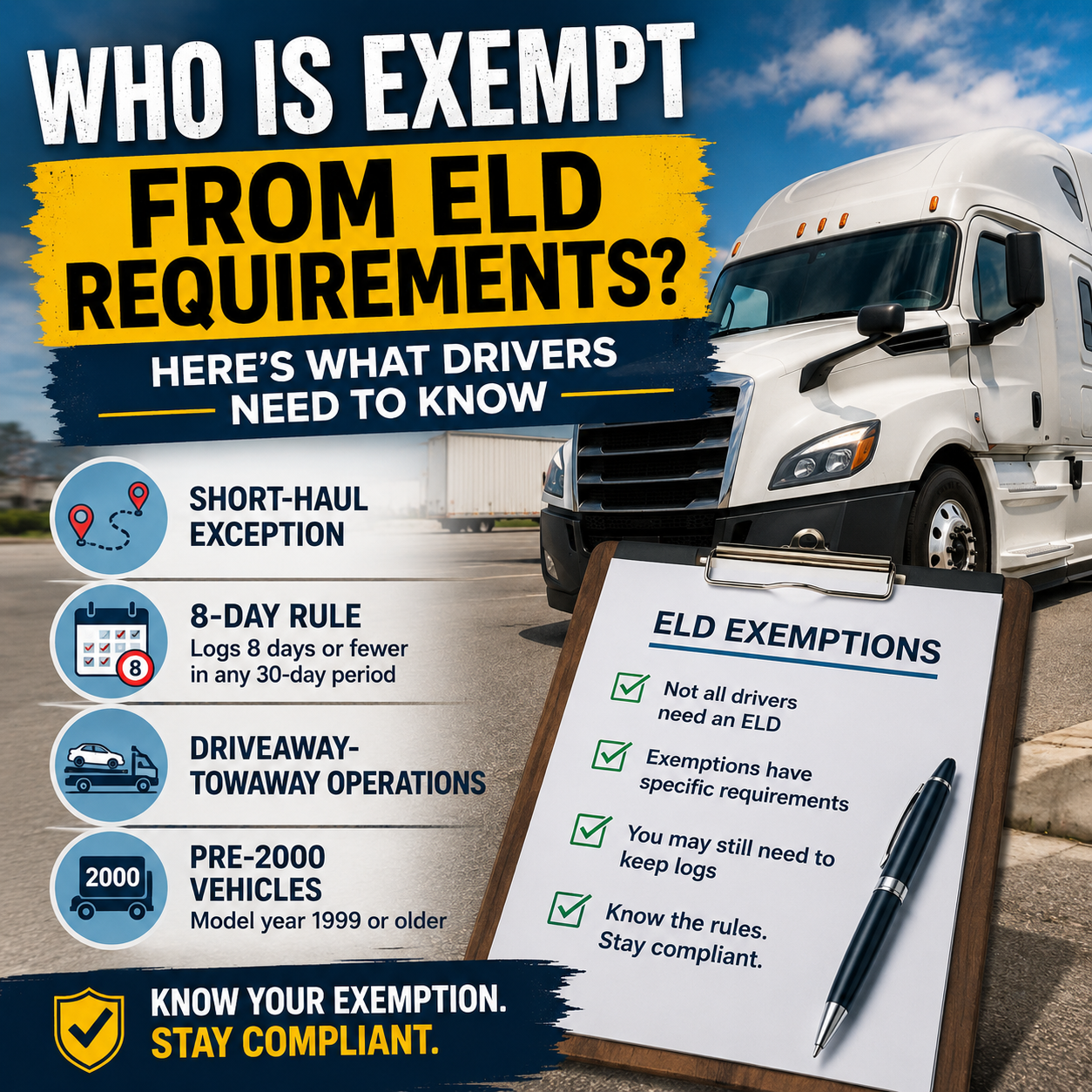
Who Is Exempt From ELD Requirements? Here’s What Drivers Need to Know
Every time ELDs come up, somebody says:
“I don’t even need one. I’m exempt.”
Sometimes they’re right.
Sometimes they’re about to find out they misunderstood the rule.
That’s why ELD exemptions can get tricky. A driver may be exempt from using an ELD, but that doesn’t always mean they’re exempt from Hours of Service rules or recordkeeping altogether.
So let’s break this down in plain English.
First, Being Exempt From ELDs Does Not Always Mean Exempt From Logs
This is where a lot of drivers get crossed up.
Some drivers are exempt from using an electronic logging device, but they may still have to keep records of duty status when required.
In simple terms:
ELD exemption does not automatically mean HOS exemption.
That’s the part that can get a driver in trouble during an inspection.
Don’t just ask, “Do I need an ELD?”
Ask, “Do I still need to keep logs today?”
Short-Haul Drivers May Not Need an ELD
The short-haul exception is one of the most common reasons drivers believe they are exempt.
If you operate under the short-haul exception, you may not be required to use an ELD because you may not be required to keep regular records of duty status.
But here’s the part drivers need to pay attention to:
You have to actually meet the short-haul requirements.
If your operation changes, your exemption may change with it.
That means if you normally run local but occasionally go outside your normal limits, that day may not be treated the same.
I’ve seen drivers assume “local” automatically means “exempt.”
That’s not always true.
The 8-Day Rule: Occasional Logs Do Not Always Require an ELD
Another major exemption involves drivers who only need to keep paper logs occasionally.
FMCSA says drivers who are required to keep records of duty status for no more than 8 days within any 30-day period are not required to use an ELD.
This matters for drivers who usually qualify for short-haul but sometimes have a day that requires logs.
But don’t play games with this one.
If you go beyond that 8-day limit, you may no longer qualify for the exemption.
That is where a lot of small carriers and owner-operators get caught off guard.
Pre-2000 Vehicles May Be Exempt
Drivers of vehicles manufactured before model year 2000 are not required to use ELDs under the FMCSA exemption.
The reason is simple.
Older trucks may not have the electronic systems needed for an ELD to connect properly.
But here’s my advice:
Do not rely on a verbal explanation at the scale house.
If you’re claiming this exemption, keep supporting documentation with the truck so you can explain it clearly during an inspection.
Driveaway-Towaway Operations May Be Exempt
Driveaway-towaway operations may also qualify for an ELD exemption when the vehicle being driven is the commodity being delivered.
This is not the same as simply hauling freight with your own truck.
If you’re transporting the actual vehicle as the product, this exemption may apply.
Again, don’t assume. Make sure the operation actually fits the rule.
Are You Sure You’re Really Exempt?
This is the question I would ask every owner-operator before they decide not to use an ELD.
Because there’s a big difference between:
- “I heard I was exempt.”
- “My operation clearly qualifies for an exemption.”
Those are not the same thing.
If you are wrong, the DOT officer probably isn’t going to care what someone told you in a Facebook group.
You need to know which exemption applies, why it applies, and what paperwork supports it.
What If Your Operation Changes?
This is where things get real for growing carriers.
You may be exempt today.
But what happens when you start running farther?
What happens when you add another customer?
What happens when your short-haul operation turns into regular over-the-road work?
That’s when your compliance setup has to grow with your business.
A lot of drivers don’t get in trouble because they ignored the rules.
They get in trouble because their business changed and their paperwork didn’t keep up.
Not Exempt? Here’s What To Look For In an ELD
If you realize you do need an ELD, don’t just grab the cheapest one you can find.
Look for a provider that invests in compliance, support, updates, and long-term reliability.
Because if FMCSA keeps tightening oversight and removing non-compliant providers, the cheap option may not stay cheap for long.
👉 Choose an ELD That Can Grow With Your Business
Final Thoughts
Not every driver needs an ELD.
But every driver needs to know whether they actually qualify for an exemption.
Don’t build your compliance plan on rumors, guesses, or what somebody said online.
Know the rule.
Know your operation.
And if your operation changes, revisit the question before DOT answers it for you.
Related Articles
Why Does FMCSA Keep Removing ELDs?
If you’re wondering why ELD providers keep getting removed from the FMCSA list, this article explains what’s really happening.
👉 See Why FMCSA Keeps Removing ELDs
Check Your Current ELD Provider
Before assuming your ELD is good, check whether your provider has already been removed from the FMCSA registry.