
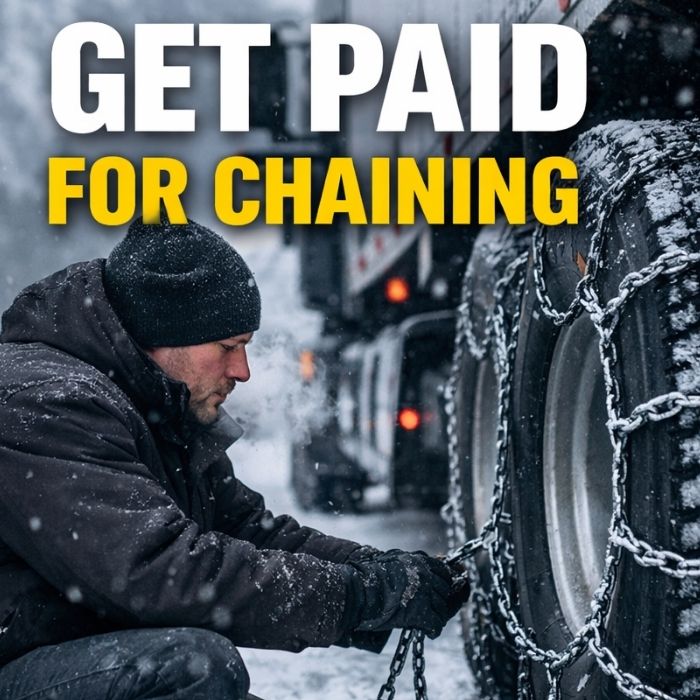
The Winter Pay Gap: Why Truckers Do More Work When the Weather Hits (and Don’t Always Get Paid)
Quick answer: The “winter pay gap” is the money drivers lose when winter adds extra unpaid work—chaining up, slower speeds, longer waits, shutdowns, detours, and higher risk—while the rate stays the same. The fix is getting winter accessorial pay (like chain pay) clearly written into the load terms before you roll.
What is the “winter pay gap” in trucking?
The winter pay gap is the difference between what the load pays on paper and what the load actually costs you in time, risk, and extra labor once winter conditions show up. Winter adds delays and tasks (like chaining) that can eat your profit if you’re paid the same flat rate.
Why does winter create more unpaid work for drivers?
Because winter turns “one load” into multiple jobs:
- Chaining up / chaining down (labor + time + cold exposure)
- Reduced speeds (same miles, more hours)
- Road closures and detours
- Longer shipper/receiver delays (weather backs everyone up)
- More breakdown risk (cold-related equipment failures)
- More shutdown decisions to stay safe and compliant
It’s like taking a run that normally burns 50 gallons… then winter makes it burn 65, but the customer still wants to pay the same “flat fuel money.” That’s the gap.
Is a broker or shipper required to pay extra for chaining up?
No federal rule forces a broker, shipper, or carrier to automatically pay “chain pay.” Chain pay is typically an accessorial charge—meaning it’s a negotiated add-on that must be agreed to in writing (rate confirmation, carrier packet terms, or a standing accessorial schedule).
What is real is this: many states do require chains (carry or use) in posted conditions, especially in mountain corridors. That’s a compliance reality—payment is a business-negotiation reality. (Example winter chain law guidance and state enforcement info are commonly updated each season.)
What’s the simplest way to stop losing money on chain-ups?
Make chain pay a default line item in your winter freight terms—same way detention, layover, and TONU are handled.
What to put in writing (before pickup)
- Chain-up pay: $___ per event (or per axle / per chain-up)
- Chain-down pay: $___ per event
- Minimum trigger: “Pay applies when chain controls are posted” (or when carrier requires chains installed)
- Proof: photo/time-stamp + location + chain control notice screenshot if available
Integrator reality: If it’s not written, it’s wishful thinking. Verbal “we’ll take care of you” doesn’t pay your maintenance account.
How do I prove a chain-up so I actually get paid?
Keep it simple and consistent:
- Photo: chains on the drive tires (wide shot + close shot)
- Time/location: phone photo metadata helps, plus a quick note (mile marker / pass name)
- Chain control proof: photo of posted signs or a state DOT chain control update screenshot when available
- Message it immediately: send to broker/dispatcher while it’s happening, not two days later
Does winter change FMCSA rules on driving time?
Winter doesn’t “change” the Hours-of-Service rules, but it does change what happens in real life. Drivers may use the Adverse Driving Conditions exception in specific cases when conditions were truly unforeseen at dispatch, and proper log annotation is required under FMCSA rules. Misusing it as a planning tool can get drivers cited.
What’s a practical “winter pay gap” checklist for owner-operators?
- Before booking: Ask “What’s the chain pay / winter accessorials?”
- Before pickup: Get it written on the rate confirmation
- During the trip: Document chain events with photo + time + location
- After delivery: Invoice accessorials immediately (don’t wait)
- Seasonal business move: Tighten your “winter minimum rate” so you’re not gambling your profit on weather
Bottom line: what should a driver do today?
If you’re chaining up this winter and not getting paid extra, you’re donating labor. Fix it the same way you fix any money leak: make it a written term and document it consistently.
Read what other truckers are reading
Sources
- Bureau of Labor Statistics (BLS) – Heavy and Tractor-trailer Truck Drivers (wage & outlook data): BLS OOH page
- Colorado State Patrol – Chain law information (official enforcement guidance): CSP Chain Law Information
- FreightWaves – Overview of truck chain laws heading into winter 2025 (multi-state context): FreightWaves chain law guide
Note: This article is educational and not legal advice. Always follow posted chain controls and official state DOT/CSP requirements on the specific route you’re running.