
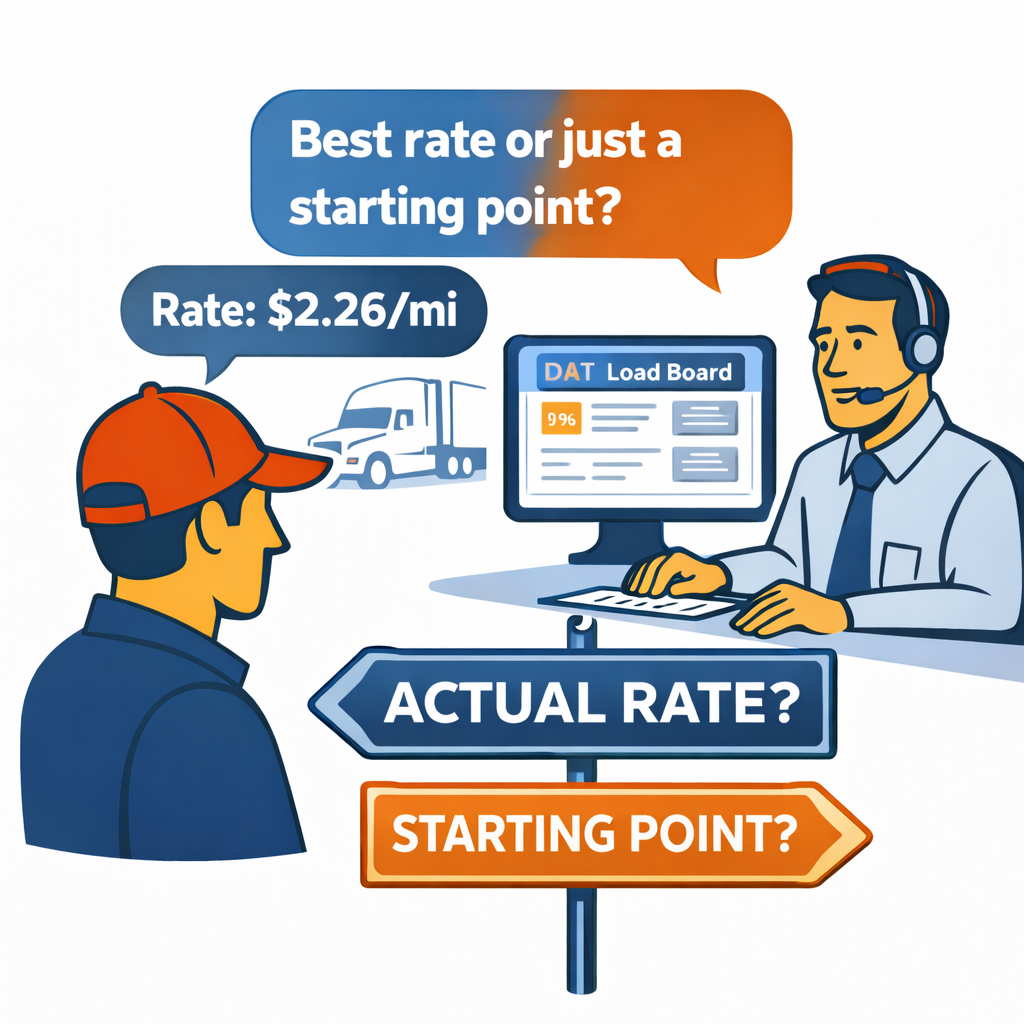
Are DAT Load Board Rates Real — or Just a Starting Point for Negotiation?
The rate you see on a load board is not a promise. It’s a number a broker posted to start a conversation.
Sometimes it’s close to what they’ll pay. Sometimes it’s a low anchor. Sometimes it’s posted fast and sloppy and the details change the math.
This guide shows you how to look at DAT rates the right way: as leverage, not truth.
Disclosure: This page contains affiliate links. If you sign up through them, I may earn a commission at no extra cost to you.
Always review pricing and eligibility at checkout. Offers can change.

Quick answer: posted rates are usually a starting point
Most of the time, the posted rate is a starting point for negotiation. The broker may have room to move based on:
- how urgent the coverage is,
- how many carriers are calling,
- pickup/appointment constraints,
- the lane’s current supply and demand,
- and how confident they are you’ll execute.
So the right mindset is: “This is the opening offer.” Not: “This is the final pay.”
Why brokers post rates that aren’t “the real pay”
1) They’re anchoring the market
Some brokers post low to see who bites. If enough carriers call, they don’t need to increase the number.
2) They posted it early (before details were finalized)
Accessorials, appointment changes, and special requirements can show up after the listing goes live.
3) They’re testing capacity
On tight lanes, brokers may post strong rates to move fast. On loose lanes, they may post low and wait.
4) The load is “real,” but the math isn’t complete
Detention policies, unloading time, and multi-stop reality can turn an “okay” load into a trap.
How to tell if a posted rate is worth calling on
Use a simple filter before you dial:
Step 1: Know your floor
If you don’t know your cost per mile and your weekly nut, you can’t negotiate—you can only hope.
Step 2: Check the lane context
Lane context tells you whether the broker’s number is realistic. If you’re using the heat map as a signal, read this next:
Lane signal guide:
How accurate is the DAT Market Conditions Index (heat map), really?
Step 3: Vet the broker before you negotiate hard
Negotiation is leverage. But leverage disappears if the broker pays slow or creates paperwork drama.
Do this before you book:
How to check broker credit score and Days to Pay on DAT (before you book)
How to negotiate off a DAT posted rate (without wasting your time)
Your goal isn’t to “win” the call. Your goal is to book a load that makes business sense.
Use a clean, professional ask
- Confirm the load details quickly (appointment, commodity, accessorials).
- Quote your number with a reason (deadhead, appointment, market tightness).
- Shut up and let them respond.
If the broker can’t move, you didn’t lose. You just saved time.

The real question: can you collect the money?
A load isn’t profitable when you book it. It’s profitable when you get paid—and the math works after expenses.
This is where a lot of drivers get burned: they chase posted rate, ignore payment behavior, and end up floating the broker for weeks.
Need faster cash flow too? Here’s DAT Factoring (Outgo):

Factoring is a cash-flow tool. Always review rates, terms, and eligibility before signing.
FAQ
Are DAT load board rates accurate?
They’re useful, but they aren’t guarantees. Most posted rates are opening offers, and the final pay depends on details, timing, and negotiation.
Why do brokers post low rates?
Because some lanes have plenty of capacity, and low rates still get covered. Brokers also use posted rates to test the market.
Should I negotiate every load?
No. Negotiate when the lane, timing, and constraints justify it. If the load is easy and the rate is strong, you may be better off booking fast.
How do I know if a broker will pay on time?
Check broker credit and Days to Pay before you commit. Good rates don’t matter if payments are slow or messy.
Broker vetting guide:
Check broker credit score and Days to Pay on DAT
What to do next
Use posted rates as leverage, not truth. The win is a load that fits your lane plan, your cost structure, and your cash flow.
If you’re still choosing a plan:
DAT Standard vs Enhanced vs Pro: which plan do you actually need?
If broker nonpayment worries you:
What is DAT Assurance—and will it actually protect you?