
Published: February 4, 2026
The $80 Per Diem Hack: How Truck Drivers Write Off Meals Without Receipts
Truck driver per diem 2026 is one of the most talked-about tax deductions — and one of the most misunderstood. Some drivers think it’s free money. Others are scared to touch it because they’ve heard horror stories about audits.
The truth sits in the middle.
If you’re a truck driver trying to lower your tax bill the right way, per diem can be powerful. But only if you understand who qualifies, how it works, and where drivers mess it up.
This guide breaks it down in plain FreightProHub language — no tax jargon, no guessing.
Prefer to watch or listen instead?
This topic is covered in the Freight Pro Hub Podcast. If you’d rather hear the breakdown in plain language, watch the episode here:
Want the full series?
Watch the complete playlist here:
Freight Pro Hub Podcast Playlist
What is per diem for truck drivers?
Per diem is a standard daily allowance the IRS allows for meals and incidental expenses when you’re traveling away from home for work. Instead of saving every food receipt, qualifying drivers can deduct a flat daily amount.
For truck drivers, this usually applies when:
- You’re driving long-haul or regional routes
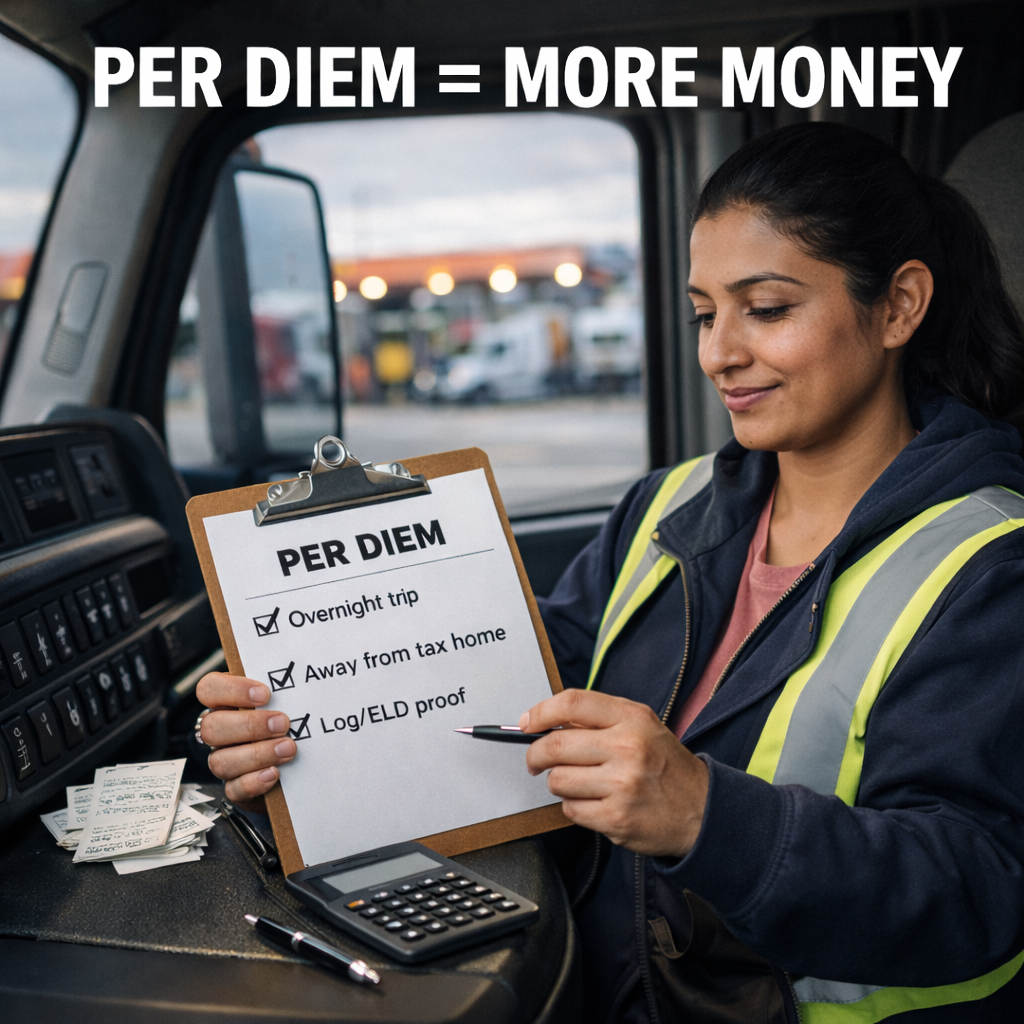
- You’re away from your tax home overnight
- You’re required to stop for rest under DOT rules
The IRS sets a daily rate, and truck drivers are allowed to use a special transportation rate instead of standard city-based rates.
What is the per diem rate for truck drivers in 2026?
The commonly referenced rate is around $80 per full day for transportation workers. That number can adjust year to year, but the concept stays the same.
Here’s what matters more than the exact dollar amount:
- You can deduct per diem per qualifying day
- You don’t need meal receipts if you use the standard rate
- You must still prove you were working and away from home
Truck driver per diem 2026 isn’t a guess. It’s a method — and methods come with rules.
Who can use per diem — owner-operators vs company drivers
This is where a lot of online advice goes sideways.
Owner-operators and self-employed drivers
If you’re an owner-operator or filing as self-employed, per diem is generally taken as a business deduction on your tax return.
That means:
- It reduces your taxable income
- It lowers both income tax and self-employment tax
- It must be backed by proper records
Company drivers (W-2)
For W-2 drivers, per diem usually shows up through an employer per diem plan. You don’t deduct it yourself on your return the same way owner-operators do.
If your company offers per diem:
- Part of your pay may be classified as per diem
- That portion is not subject to certain taxes
- You must still meet travel and overnight requirements
This difference matters. A lot.
If you want the bigger picture of how classification affects taxes, that’s covered here:
👉 1099 vs W-2 Truck Driver Taxes: What Really Changes
And if you want the full hub guide for this whole sprint:
👉 2026 Trucker Tax Guide: What OBBB Really Means
The “no receipts” part drivers misunderstand
Yes — per diem means you don’t need meal receipts.
No — it does not mean “no documentation.”
You still need to be able to show:
- Dates you worked
- Locations or routes
- That you were away from your tax home overnight
Logs, dispatch records, trip sheets, ELD records — these all matter. If you ever had to explain your work to DOT, think of this the same way. The IRS wants proof you were doing the job.
Common per diem mistakes that cost drivers money
Most per diem problems don’t come from fraud. They come from misunderstanding.
❌ Claiming per diem for local work
If you’re home every night, per diem usually doesn’t apply. Day trips don’t qualify just because you bought food.
❌ Double-dipping deductions
You can’t deduct actual meal costs and per diem for the same days. Pick one method and stick to it.
❌ No clear tax home
If you don’t have a defined tax home, per diem can get disallowed fast. This is a big audit trigger.
❌ Assuming social media advice applies to your situation
Every driver’s setup is different. Pay structure, classification, and routes all matter.
How per diem fits into the bigger tax picture
Per diem isn’t a standalone trick. It works best when it’s part of a clean, simple tax system.
Smart drivers treat it like:
- A tool to reduce taxable income
- Not a replacement for bookkeeping
- One piece of the overall strategy
That’s why we cover related topics separately instead of cramming everything into one article:
Each one matters — and each one has its own rules.
What truck drivers should do right now
If you want to use truck driver per diem 2026 without problems, here’s the FreightProHub approach:
- Confirm your classification (owner-operator or W-2)
- Confirm you qualify (overnight travel away from tax home)
- Track your work days clearly
- Use one method consistently
- Work with a tax pro who understands trucking
This keeps per diem boring — and boring is good when it comes to taxes.
Final word from FreightProHub
The $80 per diem isn’t magic, and it isn’t a loophole. It’s a legitimate IRS method that rewards drivers who do things the right way.
Used correctly, it can lower your tax bill without headaches. Used wrong, it creates problems you don’t need.
If you’re building your 2026 tax plan, per diem deserves a spot — but only as part of a complete strategy.
Combat Wisdom: Simple systems beat clever shortcuts every time.