
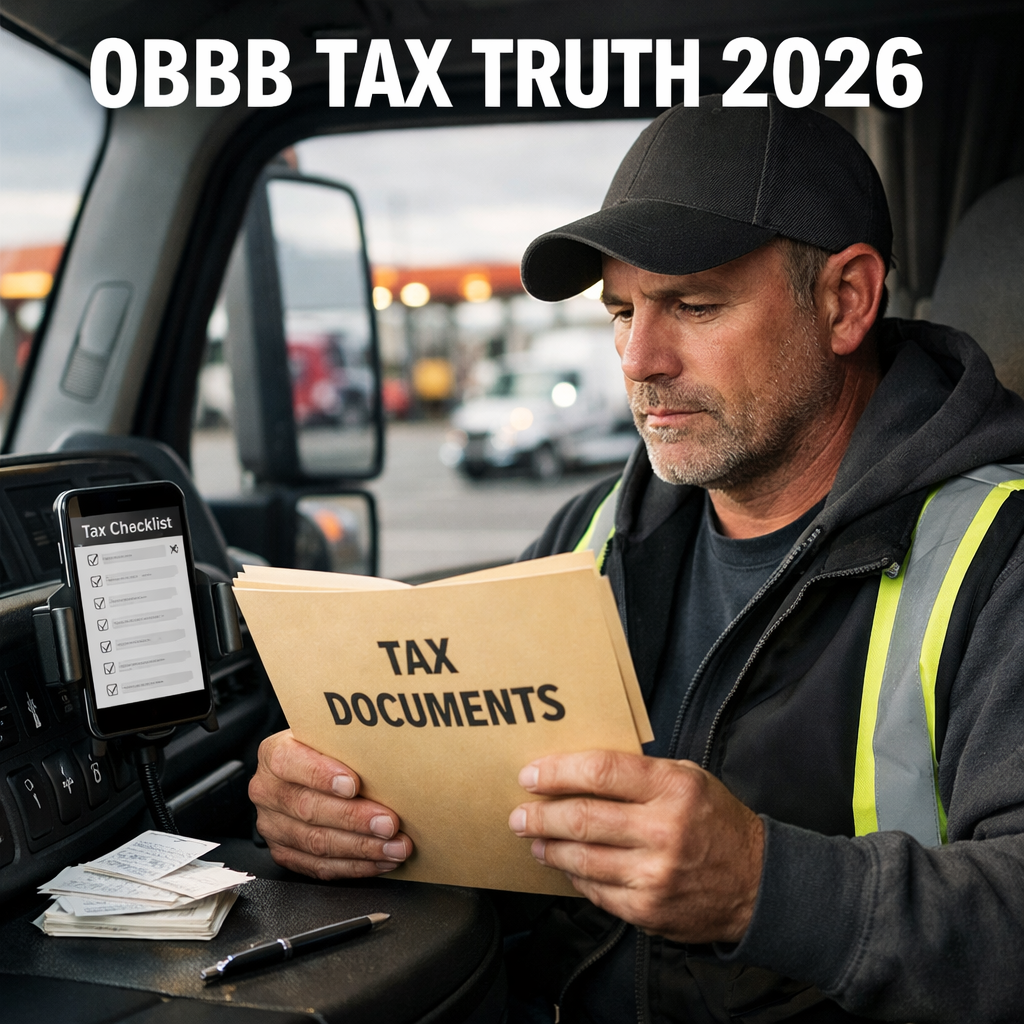
Published: February 4, 2026
2026 Trucker Tax Guide: What the One Big Beautiful Bill (OBBB) Really Means for Truck Drivers
If you’re a truck driver or owner-operator, February tax season can feel like getting dispatched to a load with half the details missing. Everybody’s talking, everybody’s posting “tax hacks,” and then you’re the one stuck trying to figure out what’s real before you file.
This guide is your one-stop FreightProHub breakdown of the One Big Beautiful Bill Act (OBBB) and the truck-driver tax topics that have been getting the most buzz — including the $7,500 truck driver tax credit talk and the overtime tax confusion.
Here’s the mission: keep it simple, keep it accurate, and keep you from planning your taxes around headlines.
Prefer to watch or listen instead?
This guide is backed by a full Trucker Tax Myths podcast series, created directly from the 7 articles linked throughout this hub. If you’d rather hear the breakdown, watch real examples, or follow along in audio format, start here.
Want the full series?
Watch the complete playlist here:
Trucker Tax Myths Podcast Series
How to use this: read the sections below for clarity and references, then use the podcast episodes to reinforce the concepts and avoid common filing mistakes.
What is the One Big Beautiful Bill (OBBB) and why are truck drivers talking about it?
The One Big Beautiful Bill Act (OBBB) is a federal law that affects taxes, credits, and deductions. The reason it matters for truck drivers is because it created a wave of online talk about “new tax breaks,” including things that are actually law and things that are still proposed.
This is where drivers get tripped up: a lot of people use “OBBB” like it’s a bucket name for everything Congress is talking about. But in real life, tax season doesn’t care about talk. The IRS cares about what is in effect and what paperwork you can support.
So as we go through this guide, I’m going to keep separating two lanes:
- Lane 1: What’s law (things that exist and can be filed once the IRS provides guidance)
- Lane 2: What’s proposed (real bills, real language — but not claimable until passed)
Is the $7,500 truck driver tax credit real for 2025 or 2026?
Here’s the straight answer: the proposal is real, but the credit is not law yet.
The truck driver tax credit everyone’s talking about comes from a separate bill proposal: the Strengthening Supply Chains Through Truck Driver Incentives Act of 2025 (introduced in the House). That bill is designed to create a refundable tax credit for qualifying commercial truck drivers — but “introduced” is not the same as “enacted.”
Why does that matter? Because you don’t want to file your 2025 or 2026 taxes expecting money that the IRS has no authority to issue yet. That’s how drivers get burned.
What the proposal says (in plain language):
- It would create a refundable credit (meaning it could still benefit you even if your tax bill is low).
- It ties eligibility to CDL status, truck-driving work, and hours worked.
- It includes income limits (AGI caps) — so not everyone would qualify even if they drive the hours.
Want the full credit breakdown? This is the post drivers are already reading:
👉 Truck Driver Tax Credit: What You Can Claim (Proposed vs. Real)
What you should do right now (smart move): even though you can’t claim it yet, you can still prepare like a professional. Track your hours, keep clean records, and don’t let tax season catch you slipping if the law changes later.
Does OBBB eliminate taxes on overtime for truck drivers?
This is where a lot of drivers got frustrated, because they heard “no tax on overtime” and assumed it applied to trucking across the board.
Reality: most truck drivers still don’t benefit from overtime provisions the way other hourly workers do, because overtime eligibility is tied to how federal labor law applies to the job. Trucking has long had special treatment under those labor rules, and that carries into how these overtime-related tax changes land.
In other words, this is not a “truckers get left out because somebody forgot us.” It’s the way the rules are written.
If you want the full breakdown — in trucker language — this is your supporting spoke article:
👉 Truck Driver Overtime Tax 2025: Who Qualifies and Why Most Don’t
Why I’m telling you this in the pillar: because drivers are building tax expectations around overtime talk. You don’t want to depend on it, then find out you’re excluded after the fact.
What does OBBB change for truckers filing taxes in 2026?
For most drivers, the biggest “impact” isn’t one magic credit — it’s the way the bill adds more attention and complexity around deductions, documentation, and eligibility rules.
Think of it like DOT enforcement: the regulations didn’t start yesterday, but when enforcement pressure increases, the same small mistakes start costing more. Tax season works the same way. When the tax conversation heats up nationwide, more drivers start filing aggressively, and that’s when problems show up.
So in 2026, your winning approach is not chasing every headline. It’s locking down the fundamentals that actually move your tax bill:
- Per diem (where allowed)
- Actual expense deductions for owner-operators
- Proper classification (1099 vs W-2 impacts what you can deduct)
- Clean documentation so you can support what you claim
How does per diem work for truck drivers in 2026?
Per diem is one of the biggest areas where drivers hear “no receipts” and assume it means “no rules.” That’s not how it works.
Per diem is basically a standard allowance method that can apply to meal and incidental expenses while traveling for work. The real issue is that the rules depend on how you’re paid and how you’re classified. A company driver and an owner-operator are not always playing under the same tax rulebook.
Why this matters: if you do per diem the wrong way, it doesn’t just reduce your refund — it can create problems you don’t want.
We’re breaking per diem out into its own full spoke article because it deserves its own lane:
👉 The $80 Per Diem Hack: How Truck Drivers Write Off Meals Without Receipts
What’s the mileage rate trap truckers keep falling into?
The mileage rate topic is simple but dangerous. A lot of people online talk like every driver can pick between “mileage” and “actual expenses” the way regular commuters do. That is not the trucking reality.
Many owner-operators are not eligible to use a standard mileage rate for a tractor the way someone would use it for a personal vehicle. The “trap” is not choosing wrong — the trap is assuming you qualify and filing like you do.
We’re breaking this into a standalone spoke article because it’s a common mistake:
👉 The Mileage Rate Trap for Truck Drivers
Does being 1099 vs W-2 change what you can write off?
Yes. This is one of the biggest “silent differences” in trucking taxes.
A lot of drivers mix the conversation and say “truck drivers can write off ____.” But that’s not how tax law works. Some deductions depend on whether you’re self-employed, whether you’re reimbursed, and whether the expense is truly a business expense.
That’s why we’re doing a specific spoke article on this:
👉 1099 vs W-2 Truck Driver Taxes: What Changes, What Doesn’t, and What Costs You
Practical takeaway: if you’re 1099, you want clean documentation and a simple system for tracking what matters. If you’re W-2, you want clarity on what you can and can’t deduct so you don’t waste time chasing myths.
What should truck drivers do right now so they don’t get caught slipping at filing time?
If you want the FreightProHub approach, it’s this: don’t scramble in April. Build a simple system in February.
Here are the actions that actually protect you:
- Track your hours. Even if you don’t qualify for every proposed benefit, clean hours support your business reality.
- Keep your paperwork tight. 1099s, W-2s, settlement statements, maintenance records, licensing fees — don’t wait until filing week.
- Stop planning around headlines. If it’s proposed, treat it like a “rate confirmation that hasn’t been signed.” It’s not real until it’s real.
- Use a tax pro who understands trucking. Not somebody who does one owner-operator return per year.
And if you want more targeted help, the spokes in this sprint will break down each major tax topic in plain language, step-by-step.
Final word from FreightProHub
The One Big Beautiful Bill created a lot of tax talk — and tax talk can either help you or confuse you. The goal isn’t to sound smart. The goal is to keep more of your money and stay out of trouble.
Bookmark this pillar. This is the hub for everything we publish about OBBB, the truck driver tax credit, overtime tax questions, per diem, and the other deductions drivers search for every February.
Combat Wisdom: Don’t build your tax plan on internet noise. Build it on what you can prove.