
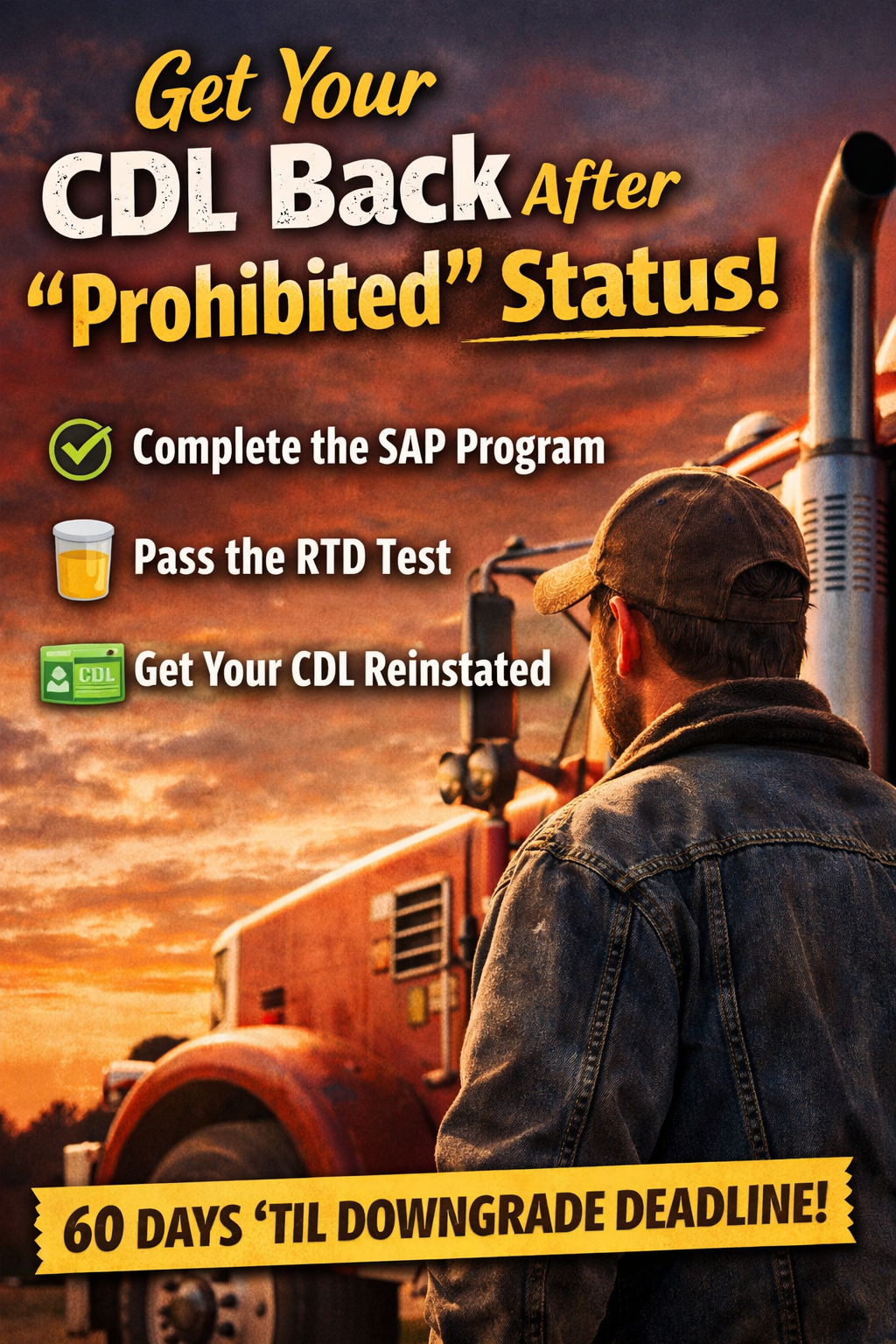
If you’re “prohibited” in the FMCSA Drug & Alcohol Clearinghouse, you’re not just benched — the state can pull your CDL privilege until you complete the Return-to-Duty (RTD) process. This post breaks down what drivers are actually typing into Google right now, in plain truck-stop talk.
1) How do I get my CDL back after a prohibited status?
Short answer: You have to go prohibited → not prohibited in the Clearinghouse by completing the DOT Return-to-Duty (RTD) steps. After that, your State Driver Licensing Agency (SDLA) can reinstate your commercial driving privileges.
Here’s the straight path:
- Stop driving CMVs immediately. “Prohibited” means you can’t do safety-sensitive driving work.
- Start the RTD process with a DOT-qualified SAP. (That’s “the guy who clears you to drive.”)
- Complete whatever education/treatment the SAP prescribes.
- Do the follow-up evaluation with the SAP.
- Take a Return-to-Duty test (drug and/or alcohol) and pass it.
- Once the negative RTD result is reported, your status can change to “not prohibited.”
- Then you deal with your SDLA to reinstate the CDL privilege. (Each state’s steps/fees can differ.)
🔥 The new reality with Clearinghouse II: As of November 18, 2024, states must remove commercial privileges for drivers in “prohibited” status, and once the state is notified, the state has 60 days to complete the downgrade. That’s why drivers are seeing “downgraded” hit faster than it used to.
Source links: FMCSA: Clearinghouse II begins (Nov 18, 2024) | Clearinghouse II Field FAQs (PDF)
2) How much does the SAP process cost in 2026?
The DOT does not set one price. The rules don’t assign payment to one guaranteed party (driver vs. employer). It’s usually based on company policy, labor agreements, and what the SAP charges.
So instead of hunting for one “price tag,” think like this:
- SAP evaluation fee (initial assessment)
- Education/treatment cost (whatever the SAP requires)
- Follow-up evaluation fee (the SAP’s “you’re compliant” check)
- RTD test cost (drug/alcohol test)
- Follow-up tests cost (minimum 6 in the first year)
Action step: Before you pay anybody, ask for a written fee schedule and confirm they are a DOT-qualified SAP operating under Part 40 rules.
Source links: FMCSA Guidance (Q11): Who pays for SAP services / follow-up testing? | DOT ODAPC FAQ: Who pays for testing/treatment?
3) Can I do a virtual SAP evaluation?
Yes — remote (“face-to-face” by video) evaluations can be allowed at the SAP’s discretion, as long as it meets the criteria in the DOT rules and the SAP’s state license allows it.
What the rule is really saying:
- It has to be a real-time, face-to-face remote evaluation (not a “fill this form out” situation).
- The video/audio quality has to be good enough for the SAP to collect the same kind of information they’d get in person.
- The tech has to protect confidentiality at industry-standard security levels.
Source link: 49 CFR Part 40 §40.291 (remote SAP evaluation criteria)
4) How long is the return-to-duty (RTD) process?
There is no DOT “2 weeks vs 2 months” guarantee because the RTD process is step-based, not calendar-based. Your timeline mostly comes down to:
- How fast you get scheduled with a SAP
- How fast you complete the education/treatment the SAP requires
- How fast the RTD test gets scheduled and reported
- Whether you already have (or can quickly get) a current/prospective employer or a C/TPA to run the test/reporting steps
Important owner-operator note: If you don’t have an employer to send you for the RTD test and report results, you may register in the Clearinghouse as an owner-operator and designate a C/TPA for the limited purpose of completing the RTD process.
Source link: Clearinghouse FAQ: RTD test/reporting when you don’t have an employer
5) Do I have to pay for my own follow-up drug tests?
DOT rules don’t force one answer. Payment can be based on employer policy/agreements. But here’s what is locked in by the rules:
- Follow-up testing is required after you return to safety-sensitive duty.
- Minimum: at least 6 follow-up tests in the first 12 months.
- Can extend: follow-up testing can continue for up to 60 months (as prescribed by the SAP).
- Direct observation: RTD and follow-up drug tests are conducted under direct observation (yes… “someone watching the cup”).
- You don’t get the schedule. The rules specifically say the schedule’s frequency/duration can’t be shared with the employee.
Translation: If you’re trying to “time it,” you’re already thinking wrong. This phase is built to be unpredictable.
Source links: DOT ODAPC: Employee RTD + follow-up testing overview | FMCSA Safety Planner: Follow-up testing (min 6 in 12 months) | 49 CFR Part 40 §40.307 (no schedule shared)
Truck-Stop Reality Checks (Read This Twice)
- “The state has 60 days to pull your CDL.” Once your SDLA is notified you’re prohibited, they have 60 days to complete the downgrade. Don’t sit on it. (source)
- “You can’t just wait 5 years for it to fall off.” Clearinghouse violation records are available for release to employers for five years or until the violation is resolved through RTD + follow-up plan, whichever is later. (source)
- “The SAP is the only person who can unlock the door.” The SAP is the required gatekeeper in the RTD process — nobody can “override” that with a phone call. (source)
- “Expect at least 6 observed tests in the first year.” Minimum six in 12 months, and they’re under direct observation. (source)
Free Resource
Want the compliance basics organized? Download the free checklist bundle here:
👉 Free DOT Compliance Checklist Bundle
Read What Other Truckers Are Reading
👉 What Happens If You Fail a DOT Drug Test?
Regulations Disclaimer
This article is educational and based on federal DOT/FMCSA guidance. Rules and state reinstatement steps can change. Always verify with FMCSA/DOT resources and your State Driver Licensing Agency (SDLA).
Sources (Official / Primary)
- FMCSA Clearinghouse: Clearinghouse II & CDL downgrades (Nov 18, 2024)
- Clearinghouse II Field Questions & Answers (PDF)
- 49 CFR Part 40 §40.291 (SAP duties + remote evaluation criteria)
- 49 CFR Part 40 §40.307 (follow-up testing plan rules)
- DOT ODAPC: Employee RTD + follow-up testing (direct observation, minimum 6)
- FMCSA Safety Planner: Return-to-Duty process
- FMCSA Safety Planner: Follow-up testing (minimum 6 in 12 months)
- FMCSA Guidance Q11: Who pays for SAP services/follow-up testing?
- DOT ODAPC FAQ: Who pays for testing/treatment?
- FMCSA Guidance: How long Clearinghouse violations are available (5 years or until resolved)
- Clearinghouse FAQ Topics (RTD without an employer / C/TPA)