
Published: February 24, 2026
Random DOT Drug Test on the Road: What Owner-Operators Need to Know
Getting a random notification while you’re under a load creates real pressure. The clock starts now — but “immediately” doesn’t mean you abandon safety. It means you avoid unnecessary delay and move straight toward the collection site as soon as you can safely do so.
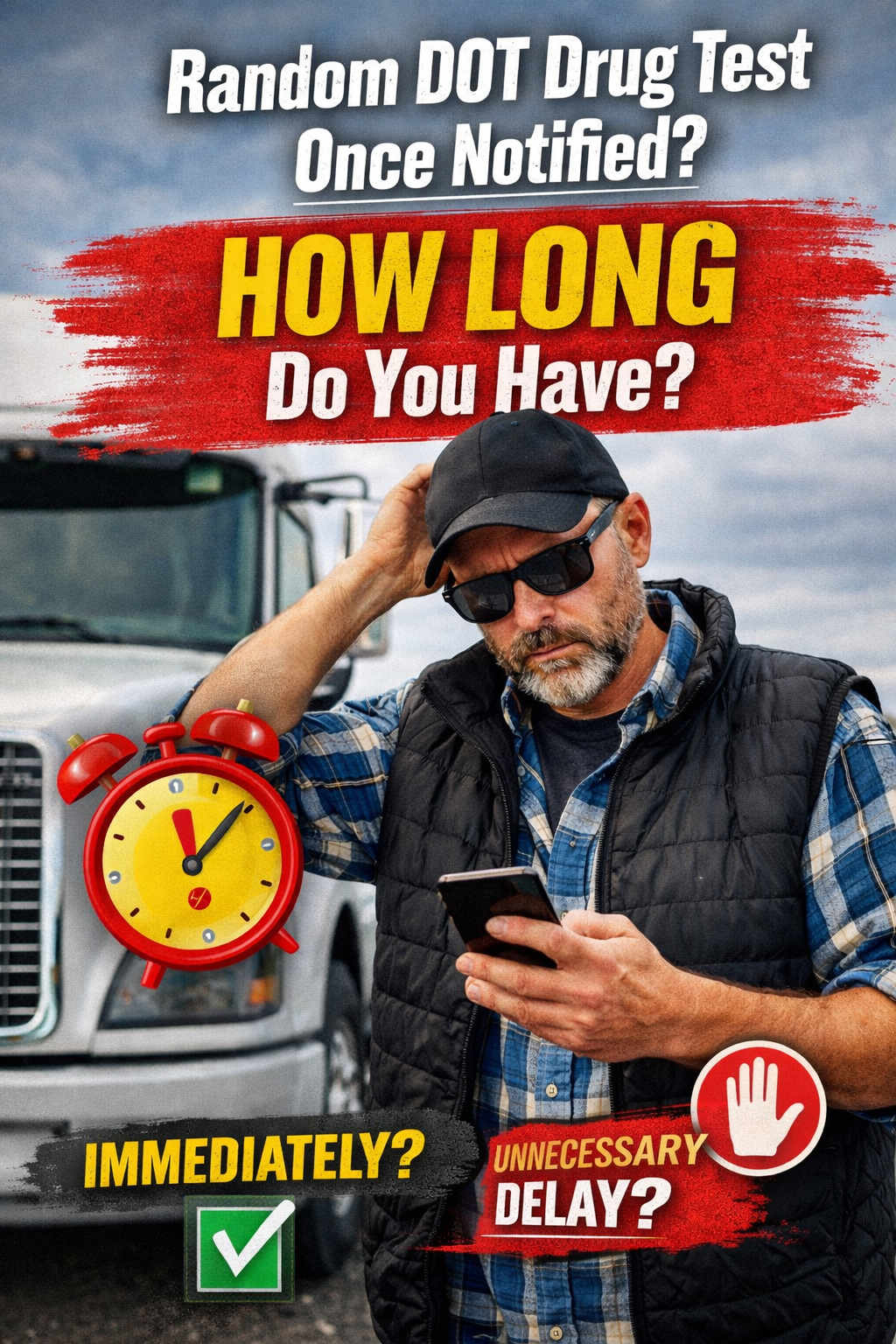
How long do I have to get a random drug test once notified?
Once you receive a valid Consortium/TPA notification for a random DOT drug test, you must proceed to the collection site immediately. You may complete only the safety-sensitive function you are actively performing (for example, safely parking or completing an unloading step already in motion). Any unnecessary delay can be treated as a refusal to test.
Refusal matters. FMCSA treats a refusal to test as a violation the same way it treats a positive test result. Review the refusal rule here: 49 CFR 382.211 (Refusal to Submit).
In plain language: once you get the call from the consortium, don’t “work it in when you feel like it.” Document the time, follow the instructions, and head to testing without detours.
Can I finish my delivery before taking a random DOT drug test?
Not if “finish my delivery” means continuing to drive, continuing dispatch, or running the rest of the route. You may only complete the safety-sensitive duty already in progress. After that, you must go to the collection site without unnecessary delay.
Owner-operator reality: freight is important, but compliance decides whether you’re allowed to keep your hands on the wheel.
What if I’m under a load and get a random notification?
If you’re under a load, coordinate immediately so the freight is secured while you comply. Notify dispatch (or your customer contact if you’re truly independent) and follow your Consortium/TPA instructions.
Being under a load does not pause the clock. Your job is to handle the freight responsibly and move toward the collection site as soon as you safely can.
Where can I find a DOT drug testing site with truck parking?
Start with your Consortium/TPA’s approved clinic list or collection site locator. Ask for a site that works with commercial drivers and confirm access before you roll up.
Quick move that saves headaches: call the clinic and ask, “Do you have truck parking or space for a tractor-trailer?” A lot of clinics can collect a test, but not all of them can handle a truck.
If you need your compliance system tightened up so random calls don’t turn into chaos, download the Free DOT Compliance Checklist Bundle and use the Drug and Alcohol Program Checklist to make sure your process and contacts are solid.
What counts as a refusal for a random drug test on the road?
FMCSA defines refusal in multiple ways, including failing to appear for testing without a legitimate reason, failing to remain at the collection site until the testing process is complete, or failing to provide a specimen without a valid medical explanation.
Read the refusal definition directly here: 49 CFR 382.211.
Real-world examples that can get you jammed up:
- “Let me go eat first.”
- “I’m going to finish a few stops.”
- “I’ll handle it after my 10-hour break.” (unless your Consortium/TPA specifically authorizes that timing)
- Driving around looking for a “better clinic” instead of following the approved instructions.
Bottom line: if it looks like delay for convenience, it can get treated like a refusal.
On-duty vs. off-duty: does my 10-hour break change anything?
Random testing rules apply to drivers who perform safety-sensitive functions. If you are truly off-duty and not currently performing safety-sensitive work, your employer/consortium procedures may address timing differently.
However, once official notification happens, the expectation is still fast compliance. Don’t assume a 10-hour break gives you a free pass to delay. When in doubt, follow your Consortium/TPA instructions exactly and document everything.
Where the rules come from
FMCSA drug and alcohol testing requirements for motor carriers live under 49 CFR Part 382.
DOT testing procedures (collection, MRO process, lab rules) are governed by 49 CFR Part 40.
Bottom Line
When you receive a random DOT drug test notification, the clock starts now. You may complete only the safety-sensitive function already in progress. After that, you must proceed to testing without unnecessary delay. If you delay for convenience, FMCSA can treat it as a refusal under 49 CFR 382.211.
A random test is not optional, and delay can cost you your eligibility to drive.
Action Step
Before the next random notification hits, tighten your process now:
- Confirm your Consortium/TPA contact method is current (phone/email/app).
- Know who you notify to secure the load if you get selected mid-run.
- Keep a short list of approved collection sites you can reach with a truck.
Need a clean system to follow? Download the Free DOT Compliance Checklist Bundle and use the Drug and Alcohol Program Checklist as your baseline.