
Publish date: February 18, 2026
The “Big Purge” Is Live: 550+ CDL Schools Flagged — And North Carolina Is in the Hot Seat
If you’ve been hearing “CDL mill crackdown” or “illegal CDLs” and wondering what’s real — this is the clean breakdown.
What is the “Big Purge” (February 2026) and why does it matter?
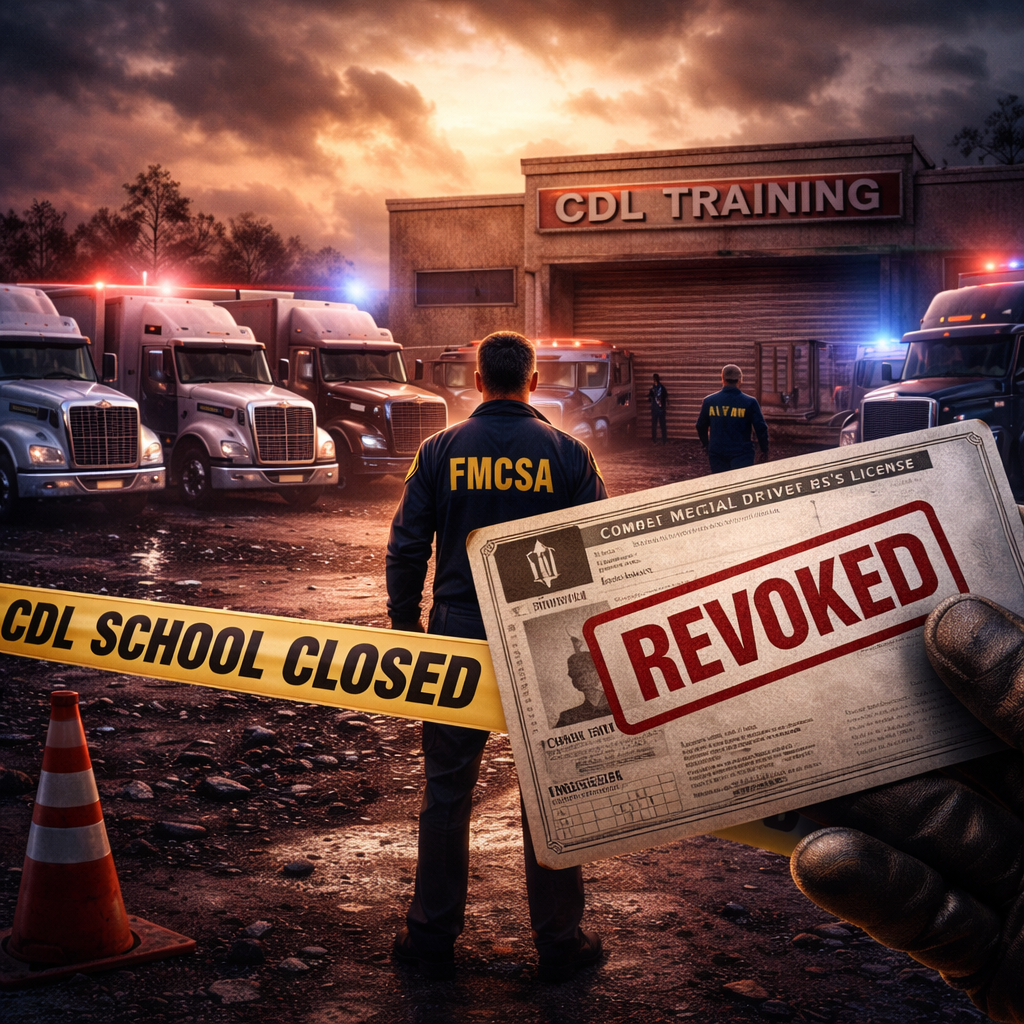
On February 18, 2026, the U.S. Department of Transportation (USDOT) announced that more than 550 CDL training schools were found in violation of federal safety standards and received notices of proposed removal from the FMCSA Training Provider Registry (TPR). USDOT says FMCSA conducted 1,426 on-site investigations in a five-day nationwide operation, using 300+ investigators across all 50 states and 1,400+ “sting operations.”
Official source: USDOT press release (Feb 18, 2026)
USDOT listed common violations like:
- Unqualified instructors (not properly licensed for what they’re teaching)
- Improper vehicles (training in equipment that doesn’t match the license/class)
- Incomplete assessments (students not properly tested)
- Schools admitting they don’t even meet their own state requirements
Translation in trucker language: some of these places will take your money, rush paperwork, and never truly train you to the current standard — and now FMCSA is actively removing them from the system.
What are “CDL mills” and what does “2022 standards” really mean?
FMCSA’s Entry-Level Driver Training (ELDT) rule went live on February 7, 2022. That’s the baseline, nationwide standard for new CDL drivers (and certain endorsements). Under ELDT, training providers must be listed on the FMCSA Training Provider Registry (TPR), and states verify training before skills/knowledge testing.
Official sources:
FMCSA ELDT overview
FMCSA Training Provider Registry (TPR) search
This crackdown is aimed at schools that can’t pass federal audits or are allegedly cutting corners on the required training framework.
Was this crackdown already happening in 2025?
Yes. In early December 2025, USDOT announced a major cleanup of the Training Provider Registry: nearly 3,000 providers were removed and another 4,500 were placed on notice for potential noncompliance.
Official source: USDOT press release (Dec 1, 2025)
So what changed in February 2026? The February operation was boots-on-the-ground enforcement: investigators physically visiting schools and issuing proposed removals based on what they found.
Why is North Carolina in the hot seat right now?
North Carolina is under federal pressure for how it handled certain non-domiciled CDLs (licenses issued to people who are not domiciled in the issuing state). According to reporting on the federal audit findings, FMCSA auditors sampled North Carolina’s non-domiciled licensing and found that 54% of the reviewed licenses were issued in violation of federal requirements.
USDOT warned North Carolina it could lose approximately $48.7 million in federal highway funds for fiscal year 2027 if the state does not correct the issues and revoke invalid licenses. The warning letter also states that FMCSA could decertify North Carolina’s CDL program if a final determination of substantial noncompliance is made.
Sources:
FreightWaves summary of USDOT letter (Jan 8, 2026)
Associated Press coverage (Jan 8, 2026)
FMCSA/DOT newsroom release (Jan 8, 2026)
What drivers need to do right now (no guessing, just the move)
1) The Training Provider Registry is king
Before anyone pays a school, they should verify the school is listed on the FMCSA Training Provider Registry.
Check it here: FMCSA Training Provider Registry (TPR) search
Why this matters: if a provider is not listed (or is under proposed removal), that can create problems with training acceptance and documentation — especially during a national enforcement wave like this.
2) “Legacy programs” tend to be safer picks
Established programs that consistently pass audits (including many public/community college programs) usually have stronger documentation, qualified instructors, proper equipment, and a cleaner compliance trail.
Note: I’m not claiming every public program is perfect — I’m saying they typically have more structured oversight than pop-up “CDL mill” setups.
3) If your CDL came through a shut-down or flagged school, don’t ignore mail
If a school is removed/flagged for fraud or noncompliance, it can trigger reviews. The practical advice is simple:
- Open every DMV/FMCSA-related letter and respond by the deadline.
- Keep your training paperwork (receipts, completion records, emails, any course documentation).
- If your status is questioned, handle it immediately — the same way you would treat a DOT audit notice.
Related FreightProHub posts (read what other truckers are reading)
- North Carolina CDL Crackdown: DOT Audit Targets Non-Domiciled Licenses
- Who Is Actually Getting Their CDL Pulled in North Carolina?
- Is My CDL at Risk Due to the “Illegal License” Audits?
Free DOT Compliance Checklist Bundle
If you want to stay ahead of enforcement waves like this, keep your paperwork tight and audit-ready.
Download the Free DOT Compliance Checklist Bundle
Sources
- USDOT: Moves to shut down hundreds of CDL mills (Feb 18, 2026)
- USDOT: Removed ~3,000 providers; ~4,500 on notice (Dec 1, 2025)
- FMCSA: Entry-Level Driver Training (ELDT)
- FMCSA: Training Provider Registry (TPR) search
- FreightWaves: DOT threatens to revoke NC CDL authority (Jan 8, 2026)
- AP: North Carolina may lose federal funds over CDL issues (Jan 8, 2026)
- FMCSA/DOT: North Carolina non-domiciled CDL audit announcement (Jan 8, 2026)
Disclaimer: This is general information, not legal advice. Always verify current requirements with FMCSA, your state DMV, and official guidance before making licensing decisions.