
Published: February 22, 2026
If you’re hearing rumors about DOT testing for fentanyl, here’s the clear answer — and what you should fix before it becomes real enforcement.
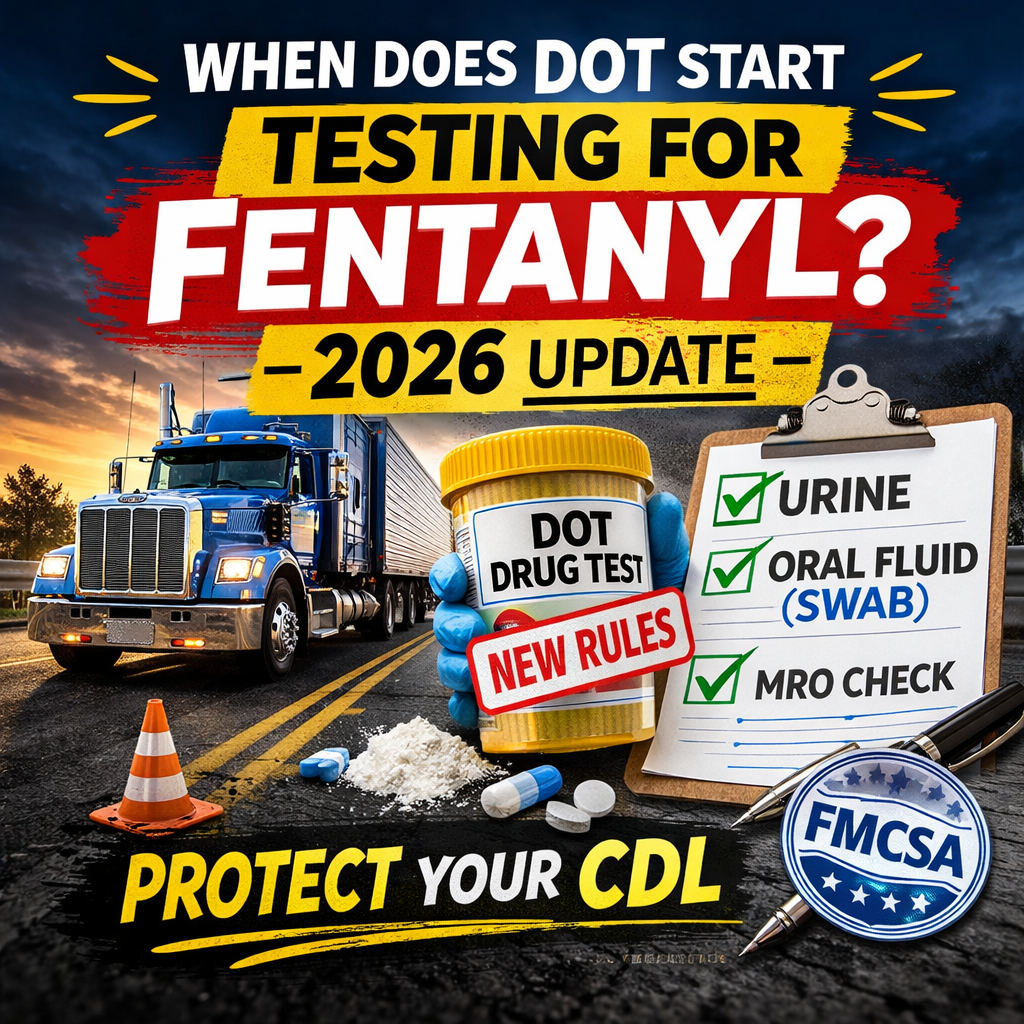
When does DOT start testing for fentanyl?
DOT has not finalized a rule requiring fentanyl testing under the federal DOT drug testing program.
On September 2, 2025, DOT proposed adding fentanyl and its metabolite norfentanyl. However, the agency has not issued a final rule or effective date. (Federal Register)
No final rule means no official start date.
However, once DOT finalizes the change, labs, consortiums, and carriers will update policies quickly. There will be no grace period for weak compliance systems.
Is fentanyl on the current DOT 5-panel test?
No.
The standard DOT test currently includes:
- Marijuana
- Cocaine
- Amphetamines
- Phencyclidine (PCP)
- Opioids (limited to specific substances)
FMCSA outlines the required drug classes here: (FMCSA)
49 CFR Part 40 governs DOT testing procedures. (eCFR)
If DOT finalizes the proposal, fentanyl becomes mandatory federal testing — not optional expanded employer testing.
Will DOT use hair, urine, or swab testing?
Under current rules:
- Urine testing is standard.
- Oral fluid testing is authorized.
- Part 40 does not permit hair testing.
DOT requires HHS-certified laboratories to process urine and oral fluid specimens. (DOT ODAPC)
In 2023, DOT finalized oral fluid procedures. (Federal Register)
If DOT adds fentanyl, most markets will likely implement urine testing first.
What if I test positive but have a prescription?
The Medical Review Officer (MRO) makes that determination — not your dispatcher or carrier.
If you provide a valid prescription and the MRO confirms a legitimate medical explanation, the MRO can verify the result as negative. (DOT ODAPC)
49 CFR §40.131 defines MRO authority. (49 CFR §40.131)
DOT does not accept Schedule I drug use as a legitimate medical explanation.
Therefore, your drug and alcohol file must stay organized and current.
If you are unsure your program is structured correctly, review your Drug and Alcohol Program Checklist inside the Free DOT Compliance Checklist Bundle.
Can second-hand fentanyl exposure make you fail?
Public health agencies state that brief, accidental second-hand exposure in public settings is extremely unlikely to cause harm. (Washington State DOH)
DOT testing uses laboratory screening, confirmation testing, and MRO review.
Medical literature explains that screening tests may produce false positives; however, confirmation testing separates preliminary results from verified positives. (AAFP)
The real risk is not second-hand exposure. The real risk is weak compliance documentation if something flags.
Why this matters for FMCSA compliance
If DOT adds fentanyl to the required panel, confirmed positives will enter the FMCSA Drug & Alcohol Clearinghouse.
Return-to-duty requirements would apply under Part 40 and Part 382. (FMCSA)
If you do not fully understand the process, review your Return to Duty Process Guide (FMCSA).
Owner-operators should also confirm their Driver Qualification File Checklist and DOT Audit Survival Checklist are structured correctly before enforcement expands.
Bottom Line
Fentanyl is not currently part of the required DOT testing panel.
However, DOT has proposed adding fentanyl and norfentanyl. Once finalized, enforcement will move quickly. (Federal Register)
Smart operators fix compliance gaps before regulators expand enforcement.
Action Step
1. Confirm your contact information is current for MRO communication.
2. Keep prescription documentation organized.
3. Verify your drug and alcohol testing program remains compliant.
Download the full Free DOT Compliance Checklist Bundle for structured guidance.
- Drug and Alcohol Program Checklist
- Driver Qualification File Checklist
- Return to Duty Process Guide
- DOT Audit Survival Checklist
- Record Retention & Renewal Tracker
- Vehicle Maintenance & Inspection Kit
- Accident Response & Reporting Guide
- New Entrant Safety Audit Prep Guide
- Hour of Service Quick Reference Guide
- English Language Proficiency (ELP) Guide
Do not wait for a rule change to expose weak systems.