
Published: February 4, 2026
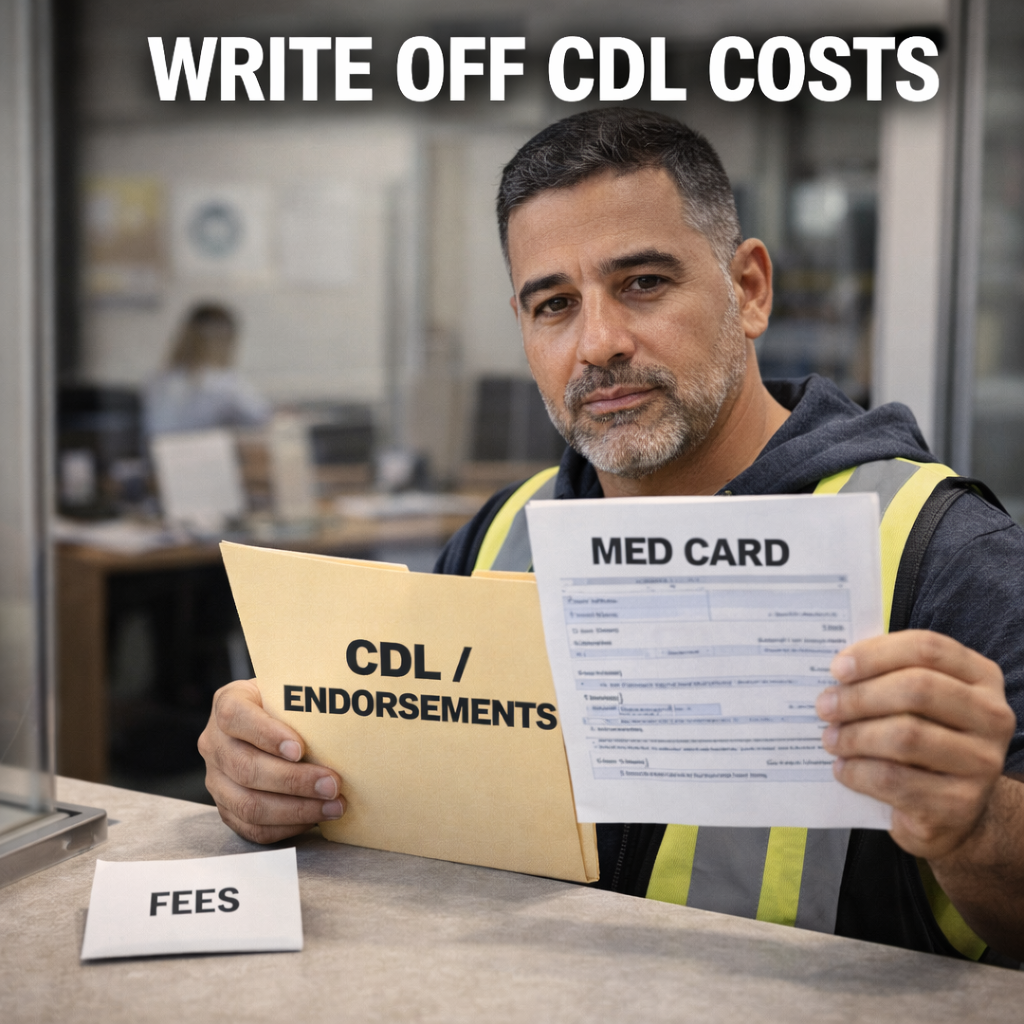
How to Write Off Your CDL, Med Card, and Endorsements (What the IRS Allows)
Are CDL fees tax deductible? That’s one of the most common questions drivers ask every tax season. The short answer is: often yes — but only when the expense is tied to keeping your current job, not qualifying for a new one.
If you want the bigger 2026 tax picture first (without the noise), this post plugs into the main hub here:
👉 2026 Trucker Tax Guide: What OBBB Really Means
This article breaks down exactly when you can write off your CDL costs, DOT medical card, and endorsements, when you can’t, and how to document them so they actually hold up.
No fluff. No myths. Just the rules that matter.
What kinds of driver-related costs can be deductible?
For tax purposes, the IRS looks at whether an expense is ordinary and necessary for your line of work. In trucking, that includes costs required to maintain your legal ability to drive.
Common driver-related expenses include:
- CDL renewal fees
- Endorsement testing and renewal costs
- DOT medical exams and certificates
- Required background checks or fingerprinting
The key distinction is maintenance versus qualification.
Are CDL fees tax deductible for drivers already working?
CDL-related expenses are usually deductible when they are required to keep your current job.
Examples that typically qualify for self-employed drivers include:
- CDL renewal fees
- State-required testing to maintain an existing CDL
- Endorsement renewals (HazMat, Tanker, Doubles/Triples)
These expenses don’t create a new career — they allow you to continue earning income as a truck driver.
That distinction matters to the IRS.
When CDL costs are NOT deductible
Here’s where drivers get tripped up.
Costs are generally not deductible when they are used to:
- Qualify you for your first CDL
- Train you for a new profession
- Change careers into trucking
Initial CDL school tuition is usually considered a personal education expense, not a business deduction.
Once you’re already a driver, the rules change — but the starting point matters.
Outbound reference: IRS Publication 970 – Education Expenses
DOT medical card: usually deductible for self-employed drivers
Your DOT medical card isn’t optional. Without it, you can’t legally drive.
Because of that, DOT medical exams and related costs are usually considered business expenses when you’re filing as self-employed.
This can include:
- DOT physical exams
- Required follow-up evaluations
- Medical documentation fees
These expenses exist solely to keep you compliant and working.
Outbound reference: IRS Publication 535 – Business Expenses
Endorsements and certifications: what qualifies
Endorsements fall into the same category as CDL renewals — if they are required to keep doing the work you already do, they are generally deductible for self-employed drivers.
Common deductible endorsements include:
- Hazardous Materials (HazMat)
- Tanker
- Doubles/Triples
- TWIC (when required for port work)
If the endorsement is required by your carrier or the type of freight you haul, it’s usually considered a business-related cost.
Why classification matters (1099 vs W-2)
Not every driver can deduct these expenses the same way.
- 1099 drivers / owner-operators: Generally can deduct ordinary and necessary business expenses.
- W-2 drivers: Are much more limited unless the employer reimburses the cost under an accountable plan.
This distinction alone explains why two drivers can pay the same CDL fee and get very different tax results.
If you’re not clear on your classification, read this first:
👉 1099 vs W-2 Truck Driver Taxes: What Changes and What Costs You
Where drivers mess up deductions the fastest
Two common mistakes show up every year:
- Forgetting small but required costs until tax time
- Assuming “everything is a write-off” with no receipts
If you want a quick checklist of other deductions drivers forget in February, read this next:
👉 5 Last-Minute Tax Deductions Truck Drivers Miss Every Year
How these deductions fit into the OBBB tax conversation
With all the attention on the One Big Beautiful Bill (OBBB), drivers are looking for big, flashy tax changes.
But for most drivers, the real money is in not missing the basics.
CDL fees, med cards, and endorsements won’t make headlines — but they can quietly reduce your taxable income every year.
This is why they’re part of the main hub:
👉 2026 Trucker Tax Guide: What OBBB Really Means
How to document these expenses correctly
Writing something off isn’t about claiming it — it’s about proving it.
Best practices include:
- Keep receipts or confirmation emails
- Save renewal notices and certificates
- Record the date and purpose of each expense
- Store everything digitally in one place
Clean documentation keeps deductions boring — and boring is good.
Final word from FreightProHub
CDL fees, DOT medical cards, and endorsements aren’t loopholes. They’re legitimate costs of doing business in trucking.
If you’re self-employed and maintaining your ability to drive, these expenses often belong on your return.
The key is understanding why the expense exists and keeping clean records to back it up.
Read what other truckers are reading:
- 1099 vs W-2 Truck Driver Taxes
- 5 Last-Minute Tax Deductions Drivers Miss
- 2026 Trucker Tax Guide (OBBB)
Combat Wisdom: If the road requires it, the IRS usually recognizes it — when you document it right.