
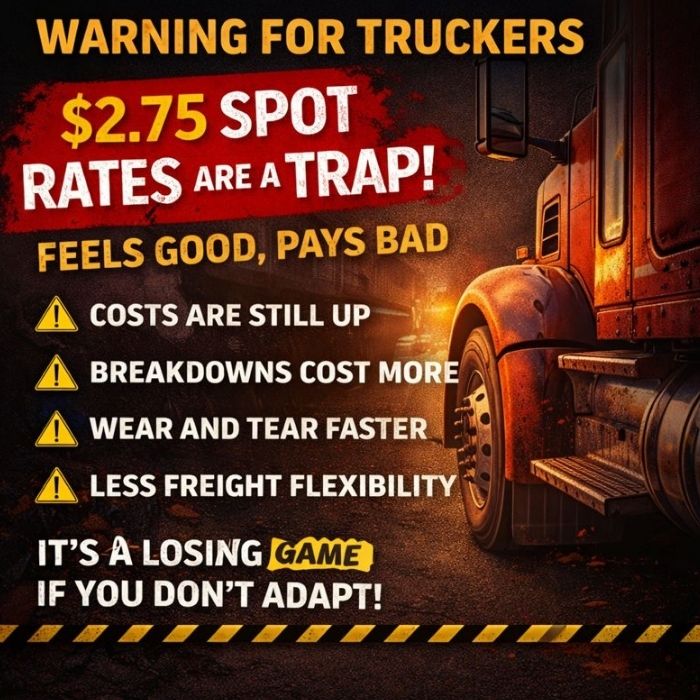
The $2.75 Trap – Why Today’s Spot Rates Are a Losing Game
If spot rates are at multi-year highs, why does it still feel like I’m broke?
Short answer: inflation ate the gains.
On paper, $2.75 per mile looks strong compared to the last few years. In reality, it doesn’t buy what it used to. Since 2020, inflation has pushed up fuel, insurance, repairs, tires, food, housing—everything you pay for between loads.
When you adjust for inflation, today’s $2.75 per mile gives you roughly 25–30% less buying power than the same rate did five years ago. To match 2020 purchasing power, that rate would need to be closer to $3.50 per mile.
You’re not imagining it. The math changed.
What is the “$2.75 trap”?
The trap is thinking: “Rates are finally back, so I should be doing fine.”
But here’s what actually happens:
- You run harder just to keep cash flowing
- Repairs cost more than expected
- Margins stay thin
- One breakdown wipes out a “good” week
The rate looks good. The net doesn’t. That’s the trap.
Is the capacity crunch finally going to push rates higher?
Yes — but not evenly, and not immediately.
Several forces are quietly removing capacity from the road:
- Revoked and non-compliant ELDs
- Broker authority revocations
- Increased scrutiny on non-domiciled CDLs
- Higher operating costs forcing weak carriers out
As “cheap” trucks disappear, capacity tightens. That gives remaining operators more leverage—but it takes time to work through the system. Many drivers won’t feel it right away.
Should I stop running spot freight and try to get a contract?
This isn’t an all-or-nothing decision.
Here’s the practical play:
- Short-term: If you can lock in a dedicated lane or contract that covers fuel, insurance, and fixed costs, it can stabilize cash flow through the slow season.
- Medium-term: Keep your spot market access alive so you’re ready to pivot when rates respond to tighter capacity.
Contracts won’t make you rich right now—but they can keep you alive long enough to capitalize later.
Why working harder isn’t fixing the problem
More miles don’t solve a margin problem.
When costs rise faster than rates:
- Every extra mile carries more risk
- Wear and tear accelerates
- Downtime becomes more expensive
This is why so many drivers feel burned out even when freight is moving. You’re doing more work for money that buys less.
What smart operators are doing right now
Experienced operators are adjusting strategy, not just grinding harder.
- Turning down marginal loads
- Watching net per mile, not just the gross rate
- Limiting deadhead
- Preserving equipment
- Protecting cash reserves
Survival mode isn’t failure—it’s positioning.
Why this matters on the road
The $2.75 trap doesn’t shut trucks down immediately. It wears them down slowly.
Drivers who ignore it often run on thin margins too long, delay maintenance, and lose flexibility when the market finally shifts. Drivers who recognize it early are still standing when opportunity comes back.
What to do this week
- Stop judging loads by gross rate alone
- Recalculate your real cost per mile with today’s prices
- Say no to freight that doesn’t leave room for repairs and downtime
- Preserve your truck and your cash—both matter
This is about staying in position, not winning this quarter.