
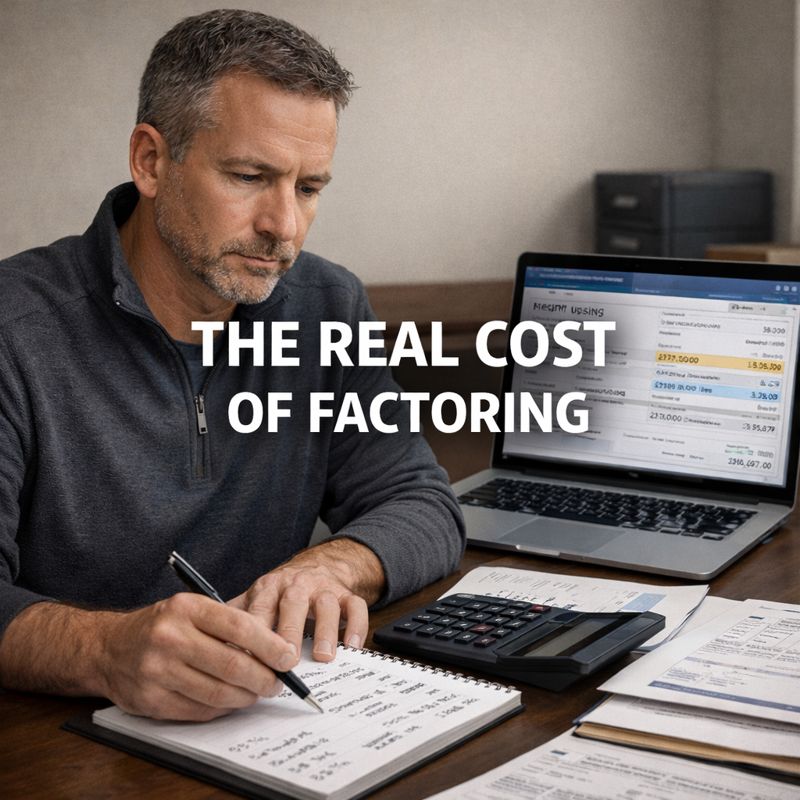
The Real Cost of Factoring — What Drivers Miss in the “Fast Pay” Pitch
What is the real cost of factoring in trucking?
The real cost of factoring in trucking isn’t just the factoring fee. It’s how often you use factoring, how your agreement is structured, and whether your loads can support fast pay without quietly killing your profit.
Owner-operators searching for freight factoring rates or invoice factoring services for truckers are usually past the learning stage. They’re comparing options and trying to avoid making an expensive mistake.
Why factoring fees feel small at first
Factoring fees are usually quoted as a percentage, which can make them seem minor on a single load. But when factoring becomes routine instead of selective, those fees compound month after month.
This is why drivers comparing factoring companies for trucking look beyond the advertised rate and focus on how factoring fits into their overall cash-flow strategy.
Advance rates, reserves, and real-world math
Most factoring programs advance a portion of the invoice upfront, then release the remainder once the broker pays, minus the agreed fees.
When drivers search for advance rate factoring, what they’re really asking is how much money they’ll have access to immediately — and how much is being held back.
The cost drivers rarely calculate
The biggest factoring cost isn’t always the fee itself. It’s using factoring on loads that were already thin on margin.
If a load barely works without factoring, adding fast pay can quietly turn it into a break-even or losing run. Factoring fixes timing — not pricing.
Why transparent factoring matters
Drivers actively searching for freight factoring services often care less about the lowest advertised rate and more about clarity.
Outgo states that its approach is designed to give carriers visibility into how factoring works, without forcing them to factor every load or commit to long-term agreements.
When factoring costs make sense
Factoring can make sense when fast access to cash helps you:
- Cover fuel, insurance, or time-sensitive expenses
- Avoid taking on debt just to bridge payment delays
- Stabilize cash flow during growth or seasonal slowdowns
The key is knowing your numbers before you factor — not after.
Read what other truckers are reading
- What Is Factoring in Trucking — And When Should an Owner-Operator Use It?
- Recourse vs. Non-Recourse Factoring — Who Eats the Loss If the Broker Doesn’t Pay?
- Factoring Contract Traps — Automatic Renewal, Exit Fees, and the Fine Print
- Factoring Alternatives — How to Improve Cash Flow Without Paying Fees on Every Load