
Published: March 1, 2026
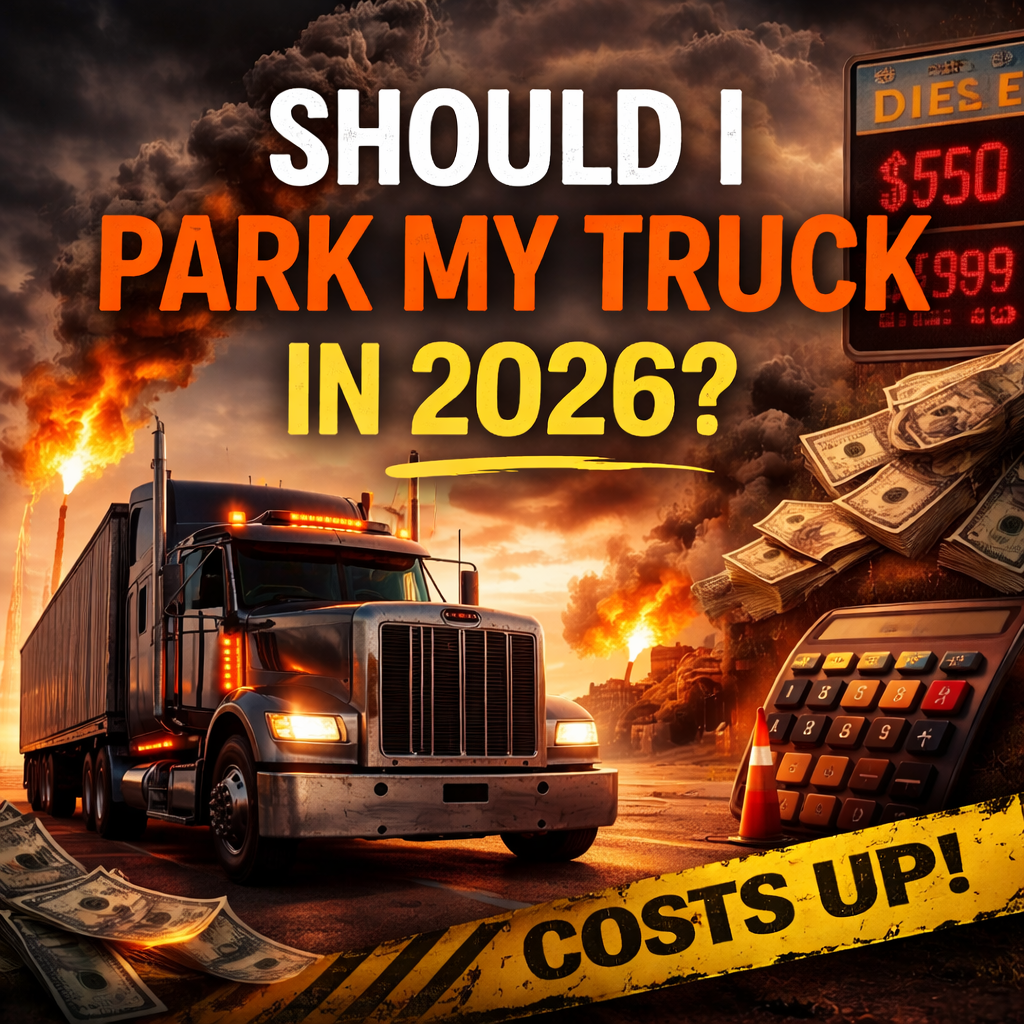
Should You Park Your Truck and Wait This Out? The Break-Even Math Most Owner-Operators Avoid
Before we get into the math: If you want the full breakdown of how fuel spikes and global tension are impacting diesel, rates, and cash flow in 2026, read this first:
Middle East Conflict & Trucking 2026: What It Really Means for Your Fuel, Freight, and Cash Flow
You’re working hard.
The wheels are turning. The logbook is full. The truck looks busy.
But your bank account doesn’t feel stronger.
You’re busy — but it doesn’t feel like you’re getting ahead.
Fuel is up. Rates feel thin. And you’ve probably asked yourself:
“Am I actually making money right now?”
Not gross revenue. Not what the rate confirmation says.
Real money. After fuel, insurance, the truck payment, and maintenance.
Let’s talk about it honestly.
Running Hard Does Not Equal Running Profitably
This is one of the hardest truths in trucking: you can be moving every day and still be losing money.
Volatile fuel markets expose it fast. If diesel jumps sharply — as tracked weekly by the U.S. Energy Information Administration (EIA) — and your revenue per mile doesn’t move with it, your margin shrinks immediately.
If your margin was already thin, it disappears.
And if you don’t know your exact cost per mile, you won’t even see it happening — you’ll just feel tired and stressed.
The Question Behind the Question
When drivers say, “Should I park?” what they really mean is:
“Is this worth it right now?”
That’s not weakness. That’s math trying to get your attention.
The Only Way to Answer It
Emotion doesn’t answer this question. Math does.
You need three numbers:
- Your true cost per mile (including fixed costs).
- Your revenue per mile (including fuel surcharge when applicable).
- Your average weekly net after all expenses.
Not what you hope to make. Not what you made last year.
What you are making right now with today’s fuel.
How Fuel Volatility Changes the Equation
Fuel spikes don’t automatically mean you should park — but they change the margin equation.
If your cost per mile rises 20–40 cents and your revenue stays flat, your break-even point shifts higher.
Loads that worked two weeks ago may not work today.
If you keep hauling them anyway, you’re funding the gap out of your reserves.
Short-term? Manageable.
Long-term? Dangerous.
Market data from platforms like DAT Freight & Analytics regularly shows how capacity tightening follows periods of fuel and rate compression.
When Parking Makes Strategic Sense
Parking is not quitting. Parking can be repositioning.
It can make sense when:
- your cost per mile is consistently higher than your revenue per mile
- you’re dipping into reserves week after week
- lane rates in your region are structurally weak
- you’re taking loads just to stay moving
That last one is emotional trucking.
And emotional trucking is expensive.
When Parking Is the Wrong Move
Parking can create new problems if:
- your cash reserves are low
- fixed bills are still due
- you don’t have a re-entry plan
- freight is volatile, but not collapsed
Sometimes adjusting lanes is smarter than shutting down.
Sometimes tightening expenses is smarter than idling completely.
Sometimes reducing deadhead solves more than parking does.
This isn’t binary. It’s strategic.
The Pride Factor Nobody Talks About
There’s ego tied to running. Truckers don’t like sitting still — it feels like losing.
But running unprofitable freight to protect pride costs more than sitting for a week to protect capital.
Your truck doesn’t care about pride.
Your numbers do.
What the Market Usually Does During Volatility
Fuel spikes.
Thin-margin carriers struggle.
Some park.
Capacity tightens.
Rates adjust upward.
But there’s a squeeze phase before the adjustment.
The operators who survive that squeeze are the ones who knew their numbers before it hit.
The ones who didn’t find out the hard way.
What You Should Do This Week
Instead of debating emotionally, do this:
- Update your cost per mile with today’s fuel.
- Compare it to your last five loads.
- Identify your true break-even rate per mile.
- Be selective with lane choice.
- Protect cash reserves.
If the math says pause — pause strategically.
If the math says run — run confidently.
But don’t guess.
Bottom Line
The question isn’t “Should I park?”
The question is: “Does this freight support my current cost structure?”
Fuel volatility doesn’t destroy disciplined operators.
It exposes undisciplined ones.
Running blind is risky.
Running informed is power.
You don’t park out of fear.
You move based on numbers.
If you want the full 2026 freight impact breakdown, go here:
Return to the 2026 Trucking Impact Guide
If you want to tighten your operation and documentation while markets are volatile, grab the free checklist bundle here: