
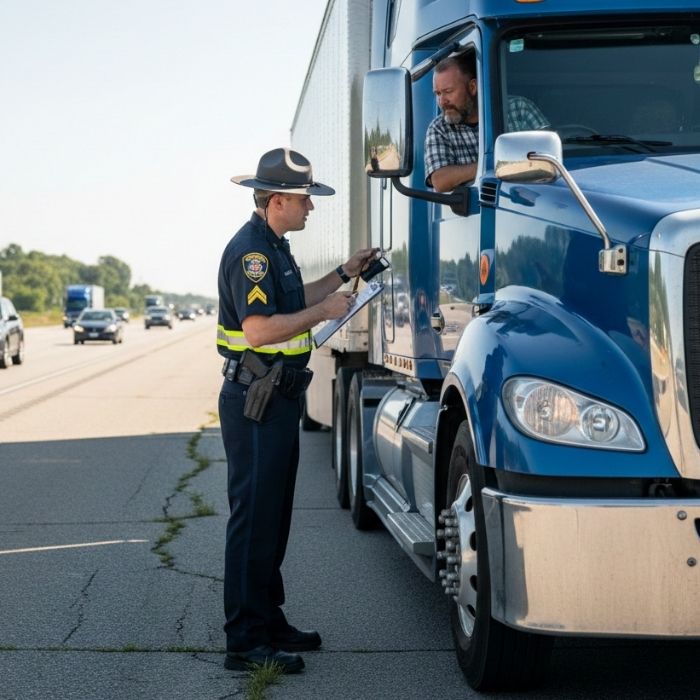
English Proficiency Roadside Checks in 2026: What DOT Officers Can Ask, What Triggers Out-of-Service, and What Carriers Should Do
So basically… this isn’t a “new rule.” It’s a stricter enforcement lane—especially at the roadside.
English language proficiency (ELP) has long been a federal driver qualification requirement under 49 CFR § 391.11(b)(2). What changed going into mid-2025 and now into 2026 is the enforcement posture: roadside inspections are being initiated in English, and failing ELP can now lead to a driver being placed out of service under the Commercial Vehicle Safety Alliance (CVSA) out-of-service criteria.
What is the English language requirement for CDL drivers?
Federal regulations require a driver to be able to read and speak English sufficiently to:
- Converse with the general public
- Understand highway traffic signs and signals in English
- Respond to official inquiries
- Make entries on reports and records
This requirement is found in 49 CFR § 391.11(b)(2).
What changed in enforcement starting in 2025 (and why it matters in 2026)?
In May 2025, FMCSA issued updated enforcement guidance that advises FMCSA personnel to initiate all roadside inspections in English. The memo explains how inspectors should proceed when they have concerns about a driver’s English proficiency.
FMCSA ELP Enforcement Guidance (May 20, 2025) – PDF
Separately, CVSA announced that ELP non-compliance would be added to its out-of-service criteria. That matters because CVSA out-of-service criteria are widely used across North America by roadside inspectors.
- CVSA announcement (May 1, 2025): ELP added to Out-of-Service Criteria
- CVSA implementation update (June 25, 2025)
What does an ELP roadside “test” look like?
There is not one universal written exam. It is typically a practical assessment during a roadside inspection. Under FMCSA’s guidance, inspections begin in English, and inspectors evaluate whether the driver can communicate and understand what’s needed to safely complete the inspection process.
Think about it like this: if you can’t clearly answer basic official questions, follow directions, and understand standard signs and instructions, that becomes a safety issue at the roadside.
How many drivers have been cited or placed out of service for ELP issues?
Enforcement activity has been significant. FreightWaves reported that through October 2025, inspectors issued 6,455 ELP violations and placed 1,816 drivers out of service for the same issue during that period.
Source: FreightWaves coverage (Dec 3, 2025)
What carriers should do right now (simple and practical)
1) Assess ELP during hiring and orientation
FMCSA guidance explicitly tells motor carriers to assess a driver’s qualifications, including their ability to comply with the ELP requirements of 49 CFR § 391.11(b)(2).
Source: FMCSA guidance for motor carriers (May 22, 2025)
2) Train drivers on roadside communication
Drivers don’t need perfect grammar. But they do need to consistently handle the basics: responding to official questions, explaining shipping documents, and following inspection instructions without relying on translation apps or interpreters.
3) Make sure drivers can complete basic records
The regulation includes the ability to make entries on reports and records. If a driver cannot reliably complete required paperwork or electronic entries, that can create compliance risk beyond the roadside stop.
4) Don’t ignore this because “we’ve never had an issue”
ELP is now tied more directly to out-of-service outcomes under CVSA criteria, and enforcement guidance encourages inspectors to start in English. That combination raises the stakes for drivers and fleets.
Bottom line
Let me show you the takeaway:
English proficiency has been in the regulations for years. What’s different heading into 2026 is how it is being enforced. If a driver can’t communicate and comply during a roadside inspection, the risk isn’t just a citation—it can become an out-of-service situation that stops the load, disrupts operations, and creates a bigger compliance problem for the carrier.
📄 Download (Reference PDF)
FMCSA English Language Proficiency Enforcement Guidance (May 20, 2025)
Sources
-
eCFR — 49 CFR § 391.11(b)(2) General qualifications of drivers (English language requirement)
https://www.ecfr.gov/current/title-49/subtitle-B/chapter-III/subchapter-B/part-391/subpart-B/section-391.11 -
FMCSA — ELP Enforcement Guidance (May 20, 2025) PDF
https://www.fmcsa.dot.gov/sites/fmcsa.dot.gov/files/2025-05/FMCSA%20ELP%20Guidance%20with%20Attachments%20Final%20%285-20-2025%29_Redacted.pdf -
FMCSA — Motor carrier guidance: assessing driver ELP during hiring/qualification (May 22, 2025)
https://www.fmcsa.dot.gov/regulations/what-should-motor-carrier-do-assess-cmv-drivers-english-language-proficiency-elp-during -
CVSA — ELP added to Out-of-Service Criteria (May 1, 2025) + implementation update (June 25, 2025)
https://cvsa.org/news/elp-oosc/
https://cvsa.org/news/elp-oosc-06252025/ -
FreightWaves — Enforcement totals through Oct 2025 (Dec 3, 2025)
https://www.freightwaves.com/news/fmcsa-english-proficiency-violations-and-why-carriers-arent-being-shut-down