
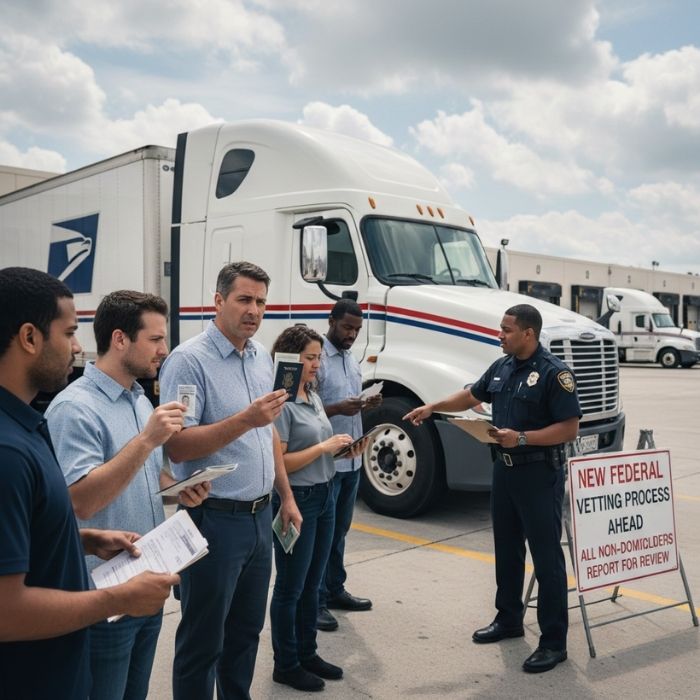
USPS Crackdown on Non-Domiciled Drivers: What Contractors and Drivers Need to Know in 2026
Current as of: January 2026
USPS is tightening enforcement on who is allowed to transport U.S. mail. Drivers must pass stricter identity and background vetting submitted by contractors as part of federal mail security requirements. Non-domiciled CDL holders are not illegal, but USPS contracts may restrict them from hauling mail. Short-term, localized delivery delays are possible — widespread mail disruption is unlikely if contractors stay compliant.
Key Terms You Need to Understand
- United States Postal Inspection Service (USPIS) – The federal law enforcement agency responsible for protecting the U.S. mail system, postal employees, and postal facilities.
- Non-Domiciled CDL Holder – A commercial driver licensed under limited-term or non-permanent U.S. residency status.
- USPS Contractor – A private company holding a Highway Contract Route (HCR) or Contract Delivery Service (CDS) agreement with USPS.
- Vetting / Clearance – Identity, background, and eligibility verification required before a driver is allowed to transport U.S. mail.
So basically, this isn’t a brand-new law — it’s stricter enforcement tied to mail security and contractor accountability.
How Do I Get Vetted to Haul USPS Mail?
This is where most of the confusion starts, so let’s clear it up.
Individual drivers do not apply directly to USPS or the Postal Inspection Service. The contractor submits driver information through USPS-approved systems, and that information is reviewed to determine whether a driver is eligible to transport U.S. mail.
USPS relies on the Postal Inspection Service to enforce access standards that protect mail integrity and prevent fraud, theft, or security risks, as outlined in its contractor and transportation security policies.
What the Vetting Process Typically Includes
- Identity verification (legal name and SSN or ITIN consistency)
- Criminal background checks
- Driving history review
- Verification of lawful U.S. work authorization
- Confirmation of permanent U.S. domicile or long-term legal residency
Okay now — here’s the part you want to make sure you understand.
If a driver cannot be verified, the contractor is required to remove that driver from USPS routes. No clearance means no access.
This is why many contractors are tightening documentation and leaning on structured systems like the FMCSA Compliance Tools to keep driver files clean, consistent, and audit-ready before enforcement issues turn into lost routes.
What Is a “Non-Domiciled” CDL Holder?
A lot of drivers hear this term and immediately assume it means “illegal.” That’s not accurate.
Domiciled CDL Holder
- U.S. citizen or lawful permanent resident
- Permanent U.S. residence
- No time-limited legal status tied to the CDL
Non-Domiciled CDL Holder
- CDL issued without permanent U.S. residency
- Often tied to temporary work authorization
- CDL validity linked to immigration status
Under FMCSA rules, non-domiciled CDL holders may legally operate commercial vehicles in the U.S. However, USPS contracts involve federally protected mail, which allows USPS to apply stricter access standards than general freight hauling.
So you want to make sure you understand this clearly:
Legal to drive a truck does not automatically mean eligible to haul U.S. mail.
Will This Cause Mail Delivery Delays in 2026?
Short answer: some delays — not a breakdown.
USPS moves thousands of contract loads every single day using private contractors and subcontracted drivers. When drivers are removed due to failed vetting, the impact can include:
- Temporary route disruptions
- Emergency reassignment of drivers
- Localized delivery delays
What is unlikely:
- Nationwide mail stoppages
- Permanent route loss for compliant contractors
- Collapse of USPS contractor operations
USPS’s priority is simple — the mail keeps moving. This enforcement effort is designed to clean up compliance, not shut down delivery.
Think about it like DOT audits. They don’t end trucking — they expose weak setups.
What Contractors and Drivers Should Do Right Now
If You’re a USPS Contractor
- Audit all driver documentation immediately
- Verify work authorization and domicile status
- Confirm driver data matches USPS submissions
- Maintain compliant backup drivers
If You’re a Driver
- Confirm whether your CDL is domiciled or non-domiciled
- Ask your contractor if you are cleared for USPS routes
- Do not assume silence equals approval
If You’re a Subcontractor
- Get written confirmation of eligibility
- Do not wait until you are pulled from a route
Bottom Line
- USPS is enforcing tighter vetting standards
- Non-domiciled CDL holders are not illegal, but may be restricted
- Short-term delivery delays are possible
- Compliant contractors will continue operating
Think about it like this: Mail is a national security asset.
USPS is treating it that way — and contractors need to as well.
All right, let’s go full blast on staying ahead of this instead of reacting late.
Sources & References
-
United States Postal Inspection Service –
Home
- USPS Contractor & Transportation Security Overview – https://about.usps.com/what/business-services/suppliers.htm
-
FreightProHub – FMCSA Compliance Tools –
FMCSA Compliance Tools