
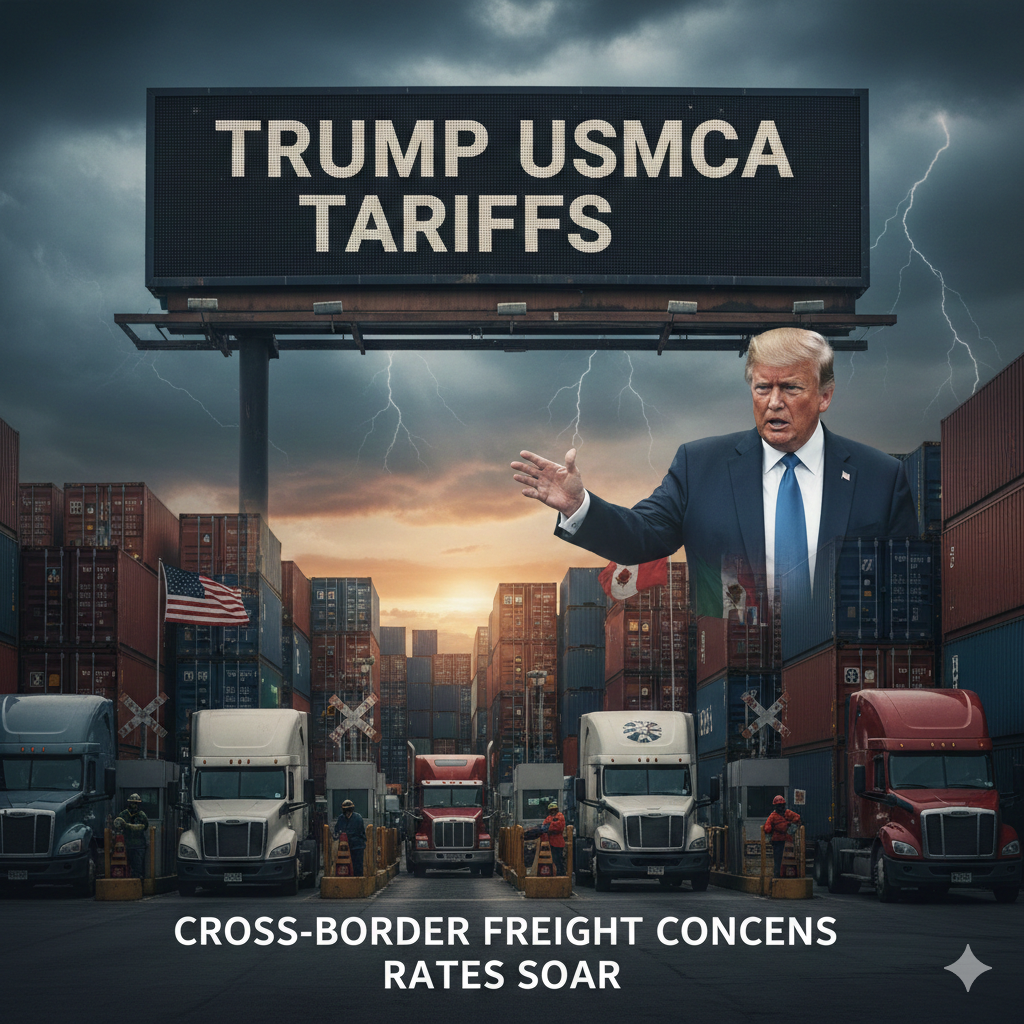
Trump’s USMCA Tariff Talk: What It Means for Your Trucking Business and Cross-Border Freight
The trucking industry is buzzing, and for good reason. Recent comments from President Donald Trump about the USMCA trade agreement have a lot of carriers asking real, money-related questions:
- Are Trump USMCA tariffs coming back?
- Will cross-border freight slow down?
- How could this affect trucking rates and lane stability?
If you’re searching for “Trump USMCA tariffs,” “cross-border freight impact,” or “how tariffs affect trucking rates,” this breakdown is for you.
What Did Trump Say About USMCA (And Why Are Truckers Paying Attention)?
Trump has publicly suggested that the current USMCA agreement does not give the U.S. a strong enough advantage. That kind of language immediately raises red flags in trucking because USMCA governs how freight moves between the United States, Mexico, and Canada.
For carriers running cross-border lanes, this isn’t political noise — it’s operational risk. Any hint of renegotiation or tariffs can change shipper behavior fast.
How Do Tariffs Affect Trucking Rates?
Tariffs are taxes on imported goods. When tariffs increase, costs move up the supply chain — and trucking feels it quickly.
- Reduced freight volume: Higher prices can lower demand, which can mean fewer cross-border loads.
- Indirect cost increases: Equipment, parts, and supplies sourced internationally can become more expensive.
- Rate volatility: Uncertainty causes shippers and brokers to hesitate, which leads to unpredictable spot rates.
This is why how tariffs affect trucking rates isn’t theoretical — it shows up in load counts and rate swings.
What Is the USMCA Agreement?
The USMCA (United States–Mexico–Canada Agreement) replaced NAFTA and sets the rules for trade across North America. It was designed to reduce tariffs, streamline border movement, and keep cross-border freight flowing efficiently.
Any change to USMCA has ripple effects across manufacturing, agriculture, and transportation.
Will Trump Tariffs Increase Cross-Border Freight Costs?
Historically, new tariffs almost always increase costs somewhere in the system. That usually leads to one of two outcomes:
- Higher freight costs: Shippers attempt to pass increased costs down the line.
- Lower freight volume: If goods become harder to sell, fewer loads move.
Even tariff talk can cause shippers to pause or shift strategy before anything is officially signed.
What Kind of Tariffs Is Trump Talking About?
Specific details have not been finalized, which is part of the concern. If tariffs target specific industries — such as automotive or agriculture — the impact won’t be evenly spread.
Carriers are affected differently based on:
- what commodities they haul
- which border lanes they run
- how dependent they are on trade-sensitive freight
This is why searches related to USMCA renegotiation impacts keep rising.
What Should Truckers Do Right Now?
You can’t control policy, but you can control preparation. Here’s how to stay ready:
- Stay informed: Follow official updates and reliable industry sources.
- Diversify lanes: Don’t rely entirely on U.S.–Mexico or U.S.–Canada freight.
- Review contracts: Know how rate changes, delays, or surcharges are handled.
- Communicate with shippers: Ask how they’re planning for potential changes.
- Watch spot rates: Cross-border lanes usually react first.
What’s the Bottom Line on Trump USMCA Tariffs?
The biggest issue right now is uncertainty. Tariff discussions alone can disrupt freight movement, pricing, and planning.
For trucking businesses tied to cross-border freight, staying informed and flexible is the difference between reacting late and adjusting early.