
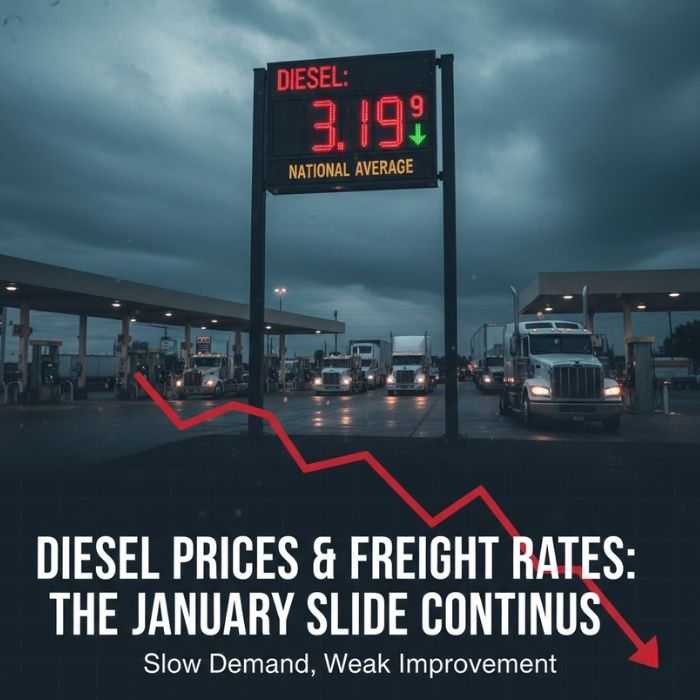
Diesel Prices and Rates: How Fuel Really Moves Your Profit (and What to Do About It)
So basically… diesel isn’t “just a cost.” It’s a rate-pressure lever. When diesel moves, your cost-per-mile moves. And if your rate structure doesn’t move with it, your profit gets squeezed.
Let me show you how to track diesel the right way, how fuel surcharges actually work, and what owner-operators and small fleets can do to protect margin.
What’s the most trusted diesel price number to watch?
Answer: The most commonly referenced benchmark in U.S. trucking is the U.S. on-highway diesel retail price published weekly by the U.S. Energy Information Administration (EIA). The EIA publishes a weekly update and also provides the historical data series. EIA Gasoline & Diesel Fuel Update
Okay now… when you hear brokers, shippers, and carriers talking about “the DOE/EIA diesel price,” this is usually what they mean. The EIA collects this through a weekly survey (Form EIA-888) and publishes it as a national benchmark. EIA methodology (how the weekly diesel price is collected)
What actually makes diesel prices go up or down?
Answer: EIA explains that retail diesel pricing reflects several components and cost layers (not just crude oil). Diesel’s retail price includes crude oil costs, refining costs/profits, distribution/marketing, and taxes. EIA: Factors affecting diesel prices
Think about it like this… your fuel bill is like the “toll” you pay to stay in business. You don’t control global oil markets, but you do control how your pricing system responds when the toll changes.
How do diesel prices connect to freight rates?
Answer: Diesel affects rates in two main ways:
-
Your operating cost moves immediately. Fuel is one of the biggest variable costs in trucking. That’s why industry cost research tracks fuel as a major component of total cost-per-mile. The American Transportation Research Institute (ATRI) publishes annual “Operational Costs of Trucking” research that includes cost trends and per-mile cost context. ATRI: Operational Costs of Trucking
-
Market rates don’t always move fast enough. Spot rates can lag behind fuel spikes—especially when capacity is loose. That’s where your pricing structure matters more than “hoping the market catches up.”
What’s the cleanest way to measure how fuel hits your cost-per-mile?
Answer: Use a simple formula that stays true no matter the market:
Fuel cost per mile = Diesel price per gallon ÷ Your truck’s real-world MPG
So you want to make sure you’re using your real MPG (based on actual fuel receipts and miles), not a “brochure MPG.” That keeps your rate floor grounded in reality.
What is a fuel surcharge (FSC), and why do carriers use it?
Answer: A fuel surcharge is a pricing mechanism designed to adjust transportation charges as diesel prices change. In trucking, FSC programs often reference the EIA weekly on-highway diesel price as the index point for adjustments.
There are different FSC styles (per-mile or percentage-of-linehaul). Industry education sources summarize how these structures are commonly used (for example, per-mile FSC is common in truckload and percentage FSC is common in LTL/parcel). FreightWaves: Fuel surcharge basics and common methods
All right, so… the reason FSC exists is simple: fuel is volatile, and long-term pricing needs a way to adjust without renegotiating every load.
What’s a standard fuel surcharge formula you can understand?
Answer: A widely used per-mile FSC concept is built around the difference between:
- the current indexed diesel price, and
- a baseline diesel price agreed to in the contract,
- then divided by the vehicle’s MPG.
Fuel surcharge per mile = (Current diesel price − Base diesel price) ÷ MPG
Does that make sense? This keeps the base rate more stable while the FSC absorbs fuel volatility.
What does a real-world fuel surcharge schedule look like?
Answer: One public example is the U.S. Department of Energy (DOE) household goods fuel surcharge matrix, which references weekly diesel prices and applies surcharge tables for specific tender systems. This shows how a published matrix can tie diesel-price bands to a surcharge rate. DOE: Weekly Fuel Surcharge Quick Reference (PDF)
Important: you don’t need to copy DOE’s exact matrix for your business. The key lesson is the structure: a published index + a clear table or formula + consistent application.
What’s the biggest mistake drivers make when diesel jumps?
Answer: They keep quoting the same rate while their cost-per-mile is climbing.
Think about it like this… running freight without fuel protection is like running a reefer with no temp alarm—you might not notice the damage until the load is already spoiled.
What should an owner-operator do weekly to stay ahead of diesel?
Answer: Here’s a simple weekly system you can run:
- ✅ Check the EIA weekly on-highway diesel price (benchmark)
- ✅ Update your internal “fuel cost per mile” using your real MPG
- ✅ If you use FSC, make sure your surcharge table/formula is applied consistently
- ✅ Re-check your rate floor (the minimum you’ll accept) based on updated total cost-per-mile
So basically… you’re not guessing. You’re driving the business with numbers.
Bottom line: what’s the smartest way to protect profit when diesel is unpredictable?
Answer: Build your pricing around a rate floor (based on real cost-per-mile) and a fuel adjustment method (like a surcharge or a built-in fuel component tied to an index).
Let me show you the final truth in one line:
If diesel rises and your revenue per mile doesn’t, your profit per mile shrinks.
So you want to make sure your rates aren’t just “competitive.” They’re survivable and repeatable.
Sources (Outbound Links)
- U.S. Energy Information Administration (EIA) — Gasoline & Diesel Fuel Update
- EIA — Methodology for Weekly On-Highway Diesel Fuel Price
- EIA — Factors Affecting Diesel Prices
- ATRI — Operational Costs of Trucking
- U.S. DOE — Weekly Fuel Surcharge Quick Reference (PDF)
- FreightWaves — Fuel Surcharge in Trucking (Overview)