
Did FMCSA Hide Part of the English-Proficiency Rule? Here’s What Truckers Need to Know Right Now.
“If your driver can’t do this… your company could be in violation today.”
What happened?
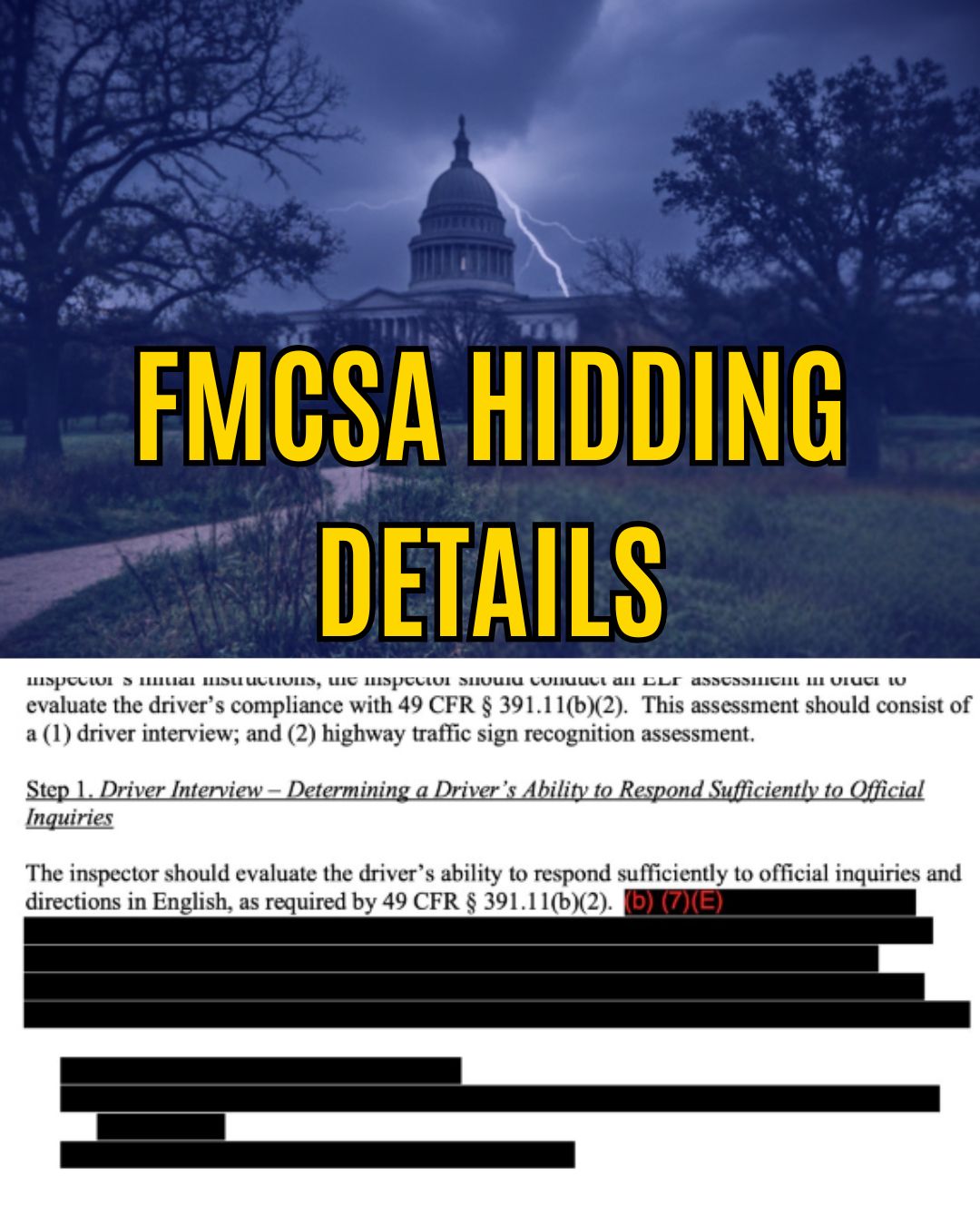
The Federal Motor Carrier Safety Administration (FMCSA) released updated enforcement guidance on the English-language proficiency requirement under 49 CFR §391.11(b)(2). But the version they published is
heavily blacked out — key details are hidden from carriers and drivers.
You can see the redacted version yourself on FMCSA’s site here:
FMCSA ELP Guidance (Redacted)
.
The Commercial Vehicle Safety Alliance (CVSA) — the people behind roadside inspections — immediately pushed back and formally requested FMCSA release the
full, unedited guidance:
CVSA Letter to FMCSA
.
So basically… FMCSA removed key parts of the playbook, enforcement is happening anyway, and carriers are left guessing.
What does the rule actually say?
What is the English-proficiency requirement for CDL drivers?
The regulation itself is clear. Under 49 CFR §391.11(b)(2), a CDL driver must be able to:
- Speak English
- Understand official inquiries (including law enforcement)
- Read and interpret highway signs and signals in English
- Make entries on reports and records in English
A plain-language breakdown of this requirement is also discussed here:
eSkill – FMCSA English-Language Requirements
.
This rule has been around for years — the enforcement details, however, are where the confusion is.
When did enforcement ramp up?
FMCSA’s internal enforcement policy went active on May 20, 2025, and the only public version is the one with major sections blacked out.
A summary of what carriers need to know is available here:
Transflo – English Proficiency Enforcement Changes
.
The bottom line: the industry is enforcing a rule without being able to see exactly how FMCSA expects enforcement officers to apply it. That’s why CVSA is demanding transparency.
Why this matters for you, your drivers, and your fleet
This isn’t about a driver having “perfect” English. It’s about whether your driver can safely communicate during:
- Roadside inspections
- Traffic stops
- Safety questions and compliance checks
- Emergency situations
If FMCSA has removed enforcement details from public view, you have no way of knowing exactly how your drivers will be evaluated — until it happens on the roadside or in an audit.
That puts you at real risk for:
- Citations
- Delays and extended inspections
- Negative inspection reports
- Audit findings
- Potential Out-of-Service (OOS) orders depending on enforcement criteria
This is a compliance blind spot you can’t ignore.
What are enforcement officers looking for?
Even though FMCSA removed portions of its guidance from public view, multiple sources give us a good picture of how this plays out in the field:
- The officer begins the interaction and inspection speaking in English.
- If the driver struggles to respond or doesn’t understand, the officer may conduct a deeper assessment.
- In some states, that can include a basic recognition test for English-language highway signs.
- Interpreter apps, cue cards, and translation tools cannot be used as a substitute for English proficiency.
More detail on how English-language enforcement is handled can be found here:
GAWDA – FMCSA English-Language Drivers
.
So basically… if the driver can’t follow the officer’s instructions in English, you have a problem before the inspection even really begins.
Q&A: What drivers and carriers are asking right now
Can a driver be placed Out-of-Service (OOS) for lacking English proficiency?
Yes. Depending on how each state incorporates the English-proficiency requirement into its Out-of-Service criteria, a driver can be placed OOS if they are found not to meet the standard. A legal breakdown is available here:
TruckSafe – FMCSA English Proficiency Enforcement Policy
.
Is the full enforcement guidance public?
No. The version FMCSA posted for the public has multiple blacked-out sections. CVSA has formally requested that FMCSA release the
full, unredacted guidance so the industry can see exactly how drivers are being evaluated. You can read that request here:
CVSA Request for Full ELP Guidance
.
How do I protect my fleet?
You need more than a checkbox on an application. You need documented proof that you checked and verified English proficiency during onboarding and training, and that your drivers can communicate effectively in real operating conditions.
What you should do today (practical action checklist)
These steps aren’t complicated — but they are necessary if you want to close this gap before an inspector or auditor finds it for you:
-
Review your onboarding process
Make sure you actually talk to your drivers in English during hiring. Ask real-world questions about routes, loads, past experience, and safety — and document that interaction. -
Update your training logs
Include English communication checks in your orientation or ongoing training. That could be basic Q&A, safety briefings, or scenario questions — as long as it’s in English and recorded. -
Document how you evaluate drivers
Keep a short note or form that shows how the driver demonstrated English ability. Don’t rely on “we just knew” or an unchecked line item. Put it in writing. -
Communicate expectations to current drivers
Let your drivers know this is now a high-focus inspection area. Encourage them to ask questions if there’s anything they don’t understand in English related to their job. -
Stay alert for the full guidance release
If FMCSA eventually releases the unedited enforcement guidance, review it and tighten your internal process to match what enforcement officers are being told to look for.
Final word
FMCSA clearly removed portions of the enforcement guidance from public view. There’s regulatory change happening behind the scenes, and your compliance radar should be up.
If your driver files don’t clearly reflect English proficiency, that’s a gap you need to fix immediately — before an inspection or audit puts a spotlight on it.
This isn’t speculation. It’s current. It’s pressing. And it’s something carriers need to handle now, not later.
For more real-world compliance updates like this, make sure you follow @FreightProHub on your favorite social media platforms.
Outbound links (verified sources)
-
FMCSA ELP Guidance (Redacted PDF):
https://www.fmcsa.dot.gov/sites/fmcsa.dot.gov/files/2025-05/FMCSA%20ELP%20Guidance%20with%20Attachments%20Final%20%285-20-2025%29_Redacted.pdf
-
CVSA Letter Requesting Full ELP Guidance:
CVSA Sends Letter Requesting FMCSA Publicly Release ELP Enforcement Guidance
-
Transflo – Changes to English Proficiency Enforcement:
https://www.transflo.com/blog/what-carriers-need-to-know-about-changes-to-english-proficiency-enforcement/
-
eSkill – Preparing for FMCSA English Requirements:
https://www.eskill.com/resources/blog/employers-how-to-prepare-for-reinforced-fmcsa-english-language-requirements/
-
GAWDA – FMCSA English-Language Drivers Alert:
FMCSA Issues Guidance on English Language Proficiency Requirements for Drivers
-
TruckSafe – FMCSA English Proficiency Enforcement Policy:
https://www.trucksafe.com/post/fmcsa-issues-enforcement-policy-on-english-proficiency