
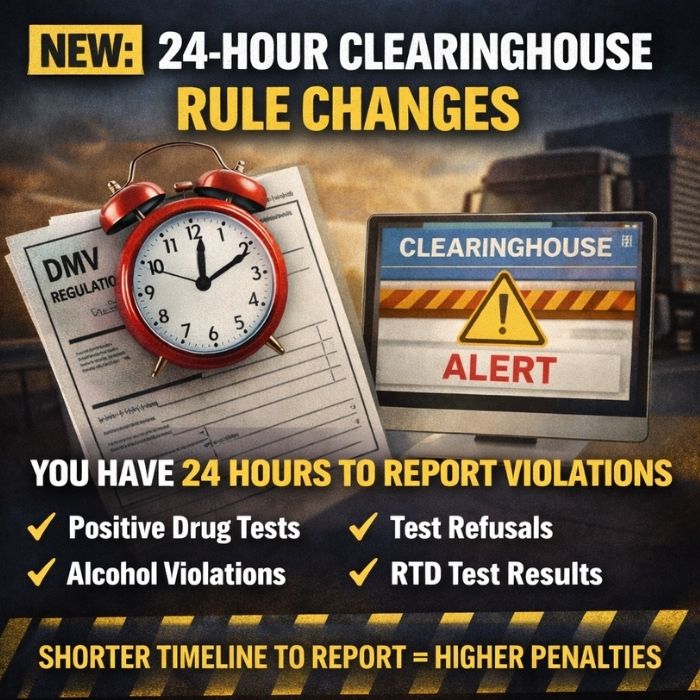
How Do the “24-Hour” Clearinghouse Rules Affect Me?
A lot of drivers are hearing “24-hour Clearinghouse rules” and thinking it means every drug/alcohol violation must be reported in 24 hours. The real rule is more specific — and if you misunderstand it, you can still get burned in an audit.
✅ Quick Answer: What is the “24-hour rule” in the FMCSA Clearinghouse?
The main “24-hour” requirement in the Clearinghouse is about queries — not general violation reporting.
Specifically: if an employer runs a limited query and the result shows that Clearinghouse records exist (“driver has information”), the employer must run a full query within 24 hours or remove the driver from safety-sensitive functions.
- FMCSA Employer Brochure (Clearinghouse): Full query within 24 hours after a limited query finds records (PDF)
🧾 So what’s the actual reporting deadline for violations?
When it comes to employer reporting of drug and alcohol program violations to the Clearinghouse, FMCSA’s rule says employers must report by the close of the third business day after they obtain the information.
- FMCSA Guidance (official): Employer violation reporting timeframe = close of the 3rd business day
- 49 CFR § 382.705 (Reporting to the Clearinghouse): Regulatory text showing employer reporting timelines
Bottom line: the “24-hour” headline you’re hearing is usually about the full query requirement after a limited query hit — not a blanket “all violations must be reported within 24 hours” rule.
⏱️ Other important Clearinghouse timelines you should know
Besides employer reporting (3 business days) and the limited-query follow-up (24 hours), there are other timelines that matter:
- MRO reporting: MROs must report certain verified drug test results to the Clearinghouse within 2 business days of determination/verification. Source
- MRO changes: if an MRO changes a previously reported result, they must report that change within 1 business day. Source
🚛 How this affects YOU as a driver
Here’s the practical impact in the real world:
- Faster “stop-driving” decisions: if an employer runs a limited query and it flags records, that company must either run a full query within 24 hours or pull you from driving until it’s resolved. (That can stop your load and your paycheck fast.)
- Less room for “we’ll fix it later”: carriers that are sloppy with reporting and queries get exposed during audits — and drivers get caught in the middle when a company suddenly scrambles to clean up Clearinghouse compliance.
- You should be registered: drivers need to be registered to provide consent for full queries and to view their own records. FMCSA Clearinghouse FAQ
🏢 How this affects motor carriers and owner-operators
If you run a company (even a small fleet), this is where the “24-hour” rule can bite you:
- Limited query hit = 24-hour countdown: your process must be tight enough to get driver consent and run the full query quickly — or remove the driver from safety-sensitive functions.
- Violation reporting still matters: employer reporting is still required by the close of the 3rd business day after you obtain the information.
- Documentation matters: in an audit, FMCSA will care about whether you ran the correct query type at the correct time, and whether your reporting timelines were met.
- Employer brochure (shows 24-hour limited→full query requirement): Clearinghouse Employer Brochure (PDF)
- FMCSA guidance (employer reporting = 3 business days): Employer Violation Reporting Timeframe
✅ What you should do today (simple checklist)
- Drivers: register in the Clearinghouse and know how to give consent quickly when a carrier requests it. Source
- Carriers: build a same-day workflow for limited query hits so you can complete the full query within 24 hours — or remove the driver until it’s done.
- Everyone: don’t rely on “what somebody said on Facebook.” Use the FMCSA guidance and the actual rule text for your compliance decisions.
🏁 Bottom line
The “24-hour Clearinghouse rule” that hits most carriers is the limited-query follow-up: if a limited query finds records, you must run a full query within 24 hours or remove the driver from safety-sensitive work. Employer reporting of violations is still generally measured in business days (close of the 3rd business day after the employer obtains the information).
📚 Sources
- FMCSA Clearinghouse Employer Brochure (PDF) — 24-hour full query requirement after a limited query hit
- FMCSA Guidance — Employer Violation Reporting Timeframe (close of 3rd business day)
- 49 CFR § 382.705 — Reporting to the Clearinghouse (regulatory text)
- FMCSA Clearinghouse FAQ — Driver data (includes MRO change reporting timing)
- FMCSA Clearinghouse FAQ — Topics overview